Thursday, 1 May 2014

What is... Thameslink?

Thameslink is a railway line connecting north and south London via St Pancras, Farringdon, Blackfriars and London Bridge. Think of it as a north-south version of Crossrail, but it's a bit old and naff by comparison. As such it's undergoing a huge £5.5 billion upgrade called the Thameslink Programme, lasting nine years, that will effectively triple Thameslink's capacity.

From when it opened in 1988 until 2009, the core section of Thameslink only got 8 trains per hour (tph) in each direction in the rush hours. By contrast, Crossrail will get 24tph in each direction (in rush hours) from the day it opens. But then Thameslink was shoehorned into an existing network not remotely designed for it: two completely separate networks north and south of the river were combined into one, meaning 8tph was the limit.

But let's start from the beginning. First, here's a map of the central section of Thameslink:
(Map based on OpenStreetMap; © OpenStreetMap contributors)
The main Thameslink line is in blue; the now-closed lines to Moorgate and Holborn Viaduct are shown in green, and the connection to the ECML which will open in 2018 is shown in yellow.

Prior to 1988, suburban services into London on the Midland Main Line (MML) from Bedford and Luton ran to St Pancras and Moorgate. A few of them went to the high level station at St Pancras, rebuilt a just few years ago for the arrival of Eurostar trains. But most used the the "City Widened Lines", a remnant of the old Metropolitan Railway, to go underneath St Pancras to Farringdon and Moorgate, which was much more convenient for the multitude of City commuters (hence the name). While trains to Moorgate couldn't call at St Pancras, they called instead at King's Cross Thameslink, a cramped pair of platforms just east of King's Cross proper on the City Widened Lines.

South of the river, most of the suburban services from Kent and Sussex used a variety of stations: about half went to Victoria; the other half went to London Bridge and on to either Charing Cross or Cannon Street. Just a small handful of trains used the two stations at Blackfriars and Holborn Viaduct, both lying on the west edge of the City and mostly eschewed in favour of Cannon Street by City commuters.

But connecting Holborn Viaduct and Farringdon, there lay the disused Snow Hill tunnel, built in 1866 to connect the Metropolitan Railway to the lins south of the river, but closed in 1916 to all but a handful of goods trains. The Greater London Council under Ken Livingstone had been campaigning for some time for its reopening, but initially that meant trying to get two completely separate regions of British Rail to work together.

In the 1980s, however, the railway was restructured: rather than five regions of BR, new "sectors" were created. Most importantly, Network SouthEast took over responsibility for all commuter services across London and the south-east, giving the railway network one voice for commuters. And Chris Green, as head of NSE, gave his enthusiastic backing to Thameslink: it symbolised perfectly the uniting of London's commuter routes into one coherent network.

In 1988, the new Thameslink service began, with trains linking Bedford and Brighton, Luton and Purley, and Cricklewood and Sevenoaks. The service was somewhat tentative at first: the off-peak service consisted of just 6tph, and they ended up clumped so that there were some 20-minute gaps. The morning rush-hour actually had fewer trains through the core, because Thameslink was merely added on top of existing rush-hour service patterns, rather than replacing them.

For example, while many of the Midland City services from Bedford and Luton now ran through the Thameslink core to Blackfriars, London Bridge and even all the way to Brighton, there was too much commuter demand to Moorgate to just close it outright and force everyone to use Farringdon. As such, Bedford-Moorgate services remained a feature of the timetable for decades to come, at first just in the peaks, but within a few years a half-hourly all day service had returned to Moorgate.

On the other side of the river, Blackfriars and Holborn Viaduct similarly continued to have rush-hour trains which terminated there and didn't run through the core to Farringdon and beyond. There was, however, a key difference between the two: Blackfriars had platforms for the through Thameslink trains to call, but they skirted Holborn Viaduct without calling, easily visible from the end of the platforms.

Having two under-used terminals was now rather unnecessary, and the decision was taken to close Holborn Viaduct and divert the remaining peak trains to Blackfriars or through the Thameslink core. But just closing Holborn Viaduct outright would lead to the Ludgate Hill area lacking any kind of railway station; it lay in the no-man's land between the Circle and Central lines, unserved by the Underground at all.

So, in an audacious plan, Network SouthEast decided to bury part of the Thameslink line just south of Holborn Viaduct - in the Ludgate Hill area, at the east end of Fleet Street - and provide a replacement station on Thameslink, underground between Farringdon and Blackfriars, so that Holborn Viaduct could finally be put out of its misery, releasing the land for valuable City development. This required ripping up the newly-reopened Thameslink line, digging out a tunnel "box" for the station, and then covering it over - not an easy task.

Holborn Viaduct station was closed on January 26th 1990, consigned to the history books. Over the next four months, the railway around Ludgate Hill was completely rebuilt. Incredibly, services continued to run through the Thameslink core during construction works, with just a two-week closure in May 1990 to finish everything off. The new station, originally St Paul's Thameslink but renamed City Thameslink soon after, opened on May 29th 1990.

By far the biggest problem for Thameslink, however, was the lack of capacity through London Bridge. With well-established commuter networks ferrying passengers by their thousands into Cannon Street and Charing Cross every weekday morning, all of which had to pass through the seven through lines on the north side of London Bridge station, rail bosses were unwilling to reduce existing services to make room for the new Thameslink services.

It's not hard to see why: the regimented service of trains arriving at two-minute intervals into Charing Cross has barely changed since the mid-1970s, principally because it works so well at getting commuters into London. Reducing the service would only serve to make overcrowding worse; and since any improvement in Thameslink services had to be matched by a corresponding decrease in services to Charing Cross, the decision was taken to give the incumbent services priority over new ones.

So from the outset, and to this day, Bedford-Brighton services ran via London Bridge in the off-peak only, when there is room to thread them through the Charing Cross services. In rush hours, the same services ran instead via Elephant and Castle, avoiding London Bridge entirely. Operationally this works reasonably well, but it deprived Thameslink commuters access to one of the biggest London stations.

In spite of all that, however, Thameslink services were well-used from the outset: those places lucky enough to get a Thameslink service saw a quadrupling in usage within just a year of opening the line. The destinations changed a number of times, but by the turn of the millennium the off-peak service had settled down to 4tph Bedford-Brighton and 4tph Luton-Sutton, the latter via the Wimbledon loop.

Indeed, Thameslink ended up becoming something of a victim of its own success: with no capacity available to increase peak services, and the platforms at Farringdon and Blackfriars only long enough for 8-car trains, something big had to happen if Thameslink was ever to solve its overcrowding problem.

Enter the Thameslink Programme: a comprehensive upgrade programme, designed to remove the capacity bottlenecks along the route and give Thameslink capacity of its own, obviating the need to share capacity with other services. Such is the extent of the upgrade that it deserves its own blogpost: click here to continue reading about the Thameslink Programme.

In the meantime, if you want to read more into the creation of Thameslink, the Network SouthEast chronology is a year-by-year history of NSE with many fascinating tidbits; indeed, the whole site is an invaluable reference.

Previous post: What is... Crossrail?
Next post: What is... the Thameslink Programme?

Monday, 28 April 2014

What is... Crossrail?

Crossrail is a new underground railway line being built in central London: 26 miles of tunnel will link Paddington in the west to Liverpool Street and Canary Wharf in the east, with connections to existing lines at either end permitting trains to Reading, Heathrow, Shenfield and Abbey Wood. Construction is costing £15 billion, and the line is expected to open in earnest in 2019.  Here's a map:
(You can see more maps on the Crossrail website.)

Note that I deliberately didn't capitalise "underground" above: Crossrail is not (just) a new London Underground (LU) line, like the Victoria line in 1968 or the Jubilee line in 1977 (extended in 1999). For many practical purposes, it will end up being a lot like an LU line; but there are three key differences between Crossrail and LU:
  1. the stations will be further apart, making it more like an "express" underground line;
  2. Crossrail will extend much further out into the suburbs;
  3. the tunnels and the trains will be larger (the same size as mainline trains).
Let's start with the first major difference, the distance between the stations. Particularly in the central tunnel, the line is best described as an "express" version of the Central line, and will bring substantial relief to long-suffering Central line commuters. While express underground lines are a radical new concept for London, they're a common feature in many other cities, most notably on the New York Subway.

Between Ealing Broadway in the west and Stratford in the east, the Central line has 20 stops; Crossrail will have just 7 in the same stretch. They are Acton Main Line, Paddington, Bond Street, Tottenham Court Road, Farringdon, Liverpool Street and Whitechapel. While Bond Street, Tottenham Court Road and Liverpool Street lie on the Central line, the route deviates north to meet the Circle line at Paddington and Farringdon, both of which will provide major interchanges with mainline rail services. It also deviates to the south to meet the Overground and the District line in another major interchange at Whitechapel.

The presence of Acton Main Line in that list betrays the second major difference: Crossrail will extend much further out than any tube line: the line will be 85 miles from end to end. To do so, it will use the existing Great Western Main Line (GWML) between Paddington and Reading, including the branch to Heathrow, and the Great Eastern Main Line (GEML) between Stratford and Shenfield in the east. (The branch to Canary Wharf and Abbey Wood, though, will be all new.)

Why extend it so far outside London proper? Currently, suburban trains to Reading arrive at Paddington, and sit for up to half an hour before going back towards Reading. That takes up valuable platform space which could be used by other trains. By transferring those trains to Crossrail, the trains can continue through to Shenfield on the other side of London, and free up those platforms at Paddington and Liverpool Street for other services.

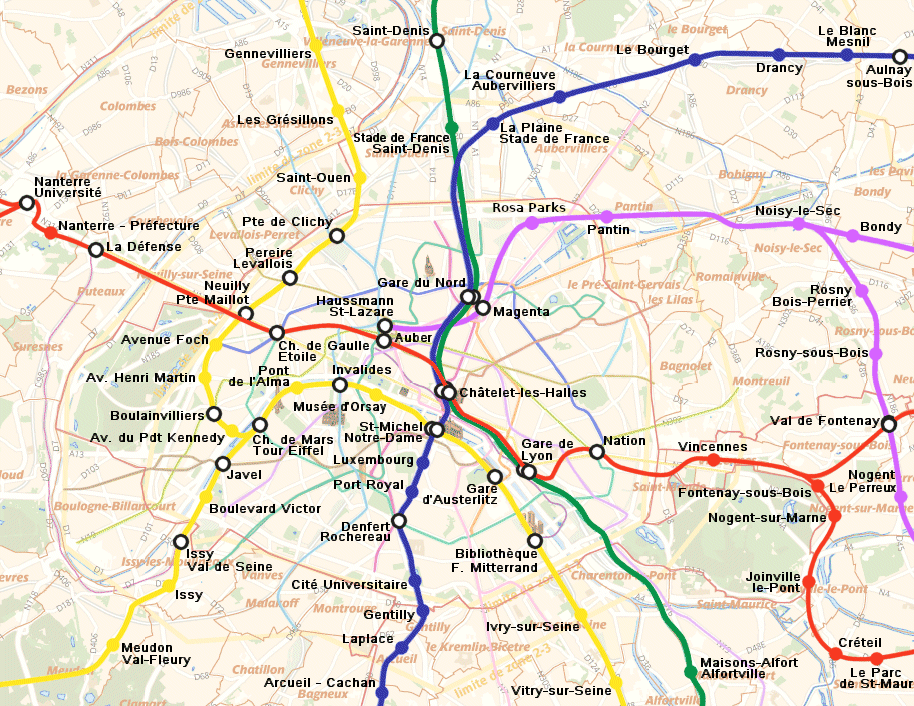
The principle isn't new: we already have Thameslink, running north-south through London (of which more in the next blogpost). But perhaps the best example is just over the channel in Paris: the RER (Réseau Express Régional) is a network of five lines criss-crossing the French capital, linking the suburbs to central Paris:
(from Wikipedia)
The RER lines connect suburban lines on either side of the French capital through a central tunnel. Indeed, RER Line A (in red) is uncannily similar to London's Crossrail: it connects western and eastern suburbs through a central tunnel, broadly parallel to Metro Line 1 but with many fewer stations. The RER has been vital in releasing capacity for medium- and long-distance trains to use Paris's six terminal stations like Gare du Nord and Gare de Lyon.

The same effect will happen at Paddington and Liverpool Street once Crossrail opens: rather than wasting as many as a third of the platforms at Paddington with local services, they will be removed to separate underground platforms and continue through to Liverpool Street and beyond, leaving more platforms at Paddington for long-distance services.

In order for that to be possible, we come to the third important difference between Crossrail and the parallel Central line: its tunnels will be the same size as mainline railway tunnels, and hence Crossrail's trains will be much bigger than tube trains.

London has long been hamstrung from being one of the pioneers of "tube" tunnels. The earliest LU lines - the modern-day Metropolitan, Circle, Hammersmith and City, and District lines - were built simply by digging up the road, laying down a railway line, and covering it over. This "cut-and-cover" method of construction was fairly easy, but it entailed colossal disruption to road traffic. Nonetheless, the tunnels were designed and sized for mainline trains, and the four "subsurface" lines remain by far the least claustrophobic part of the LU network.

Faced with the political impossibility of building more subsurface lines, attention turned from cut-and-cover tunnelling to the more novel method of boring a tunnel, without any need for direct access from above. The innovations of Brunel (senior and junior) in building the Thames Tunnel led to the Greathead shield, the first major design of tunnelling shield, and enabled tunnels to be bored through the soft clay of south London: without it, the tunnels would have collapsed under the weight of the soil above them before they could even be lined with iron or steel.

The City and South London Railway, now the Bank branch of the Northern line, was the world's first "tube" line with bored tunnels. It was also the first major railway to use electric traction, necessary if the deep tunnels were not to become filled with smoke and fumes. But the technology of the time allowed a tunnel diameter of just 10ft 2in (3.1m). Over the next two decades, improvements meant that the Central, Piccadilly and Bakerloo lines were all constructed to a common diameter of about 12ft (3.6m), with extensions to the Northern line following suit and requiring the hugely disruptive enlargement of the original C&SLR tunnels in 1923.

But there it stayed: any further enlargement of existing tunnels would have been (and would still be) effectively impossible - such is the dependence of London on its Underground that any lengthy closure of one of the lines usually causes chaos. The Jubilee line was essentially an offshoot of the Bakerloo line, so there wasn't much point building the new tunnels any larger since the old ones it had to run through were still only 12ft across.

However, the decision to build the Victoria line at the same diameter as the other four tube lines was motivated partly by a wish for compatibility, but mostly it was down to budgetary constraints (some would call it penny-pinching). Indeed, the whole Victoria line was built decidedly on the cheap and it suffers badly for it now, with stations too cramped and trains too small to truly cope with the volume of traffic.

Fortunately, the designers of Crossrail have learned their lessons: the Crossrail tunnels will be a comparatively giant 6.2m in diameter, giving tunnels with three times the cross-sectional area of the tube lines. Indeed, the impression is that nothing has been skimped from the budget at all: some of the stations will be absolutely huge, in stark contrast to the failings of the Victoria Line.

Canary Wharf station on the Jubilee line is famous for being almost cathedral-like in proportions; it was built out of a hollowed-out dock from the old docklands, and can quite happily absorb over 130,000 passengers a day. Canary Wharf Crossrail station, to be constructed from another hollowed-out dock, promises to be even bigger: the whole box will be 475m long - over a quarter of a mile!

Perhaps more important, though, is the upgrade work being undertaken at existing stations to ensure the new Crossrail services don't overwhelm the existing stations. Most notably, Tottenham Court Road station is already full to bursting at peak times with just the Northern and Central lines serving the station, and leaving it unaltered with the addition of Crossrail was not an option. So the station is being completely and painstakingly rebuilt, ensuring a total capacity for over 200,000 journeys per day once Crossrail is open.

From the outset, Crossrail will have 24 trains per hour (tph) in each direction through the central core in the rush-hours, made possible by automatic train operation (ATO). The parallel Central line has 33tph, but its trains have a much smaller cross-section and are only 130m long, compared to Crossrail's 200m-long mainline-sized trains. It is clear that Crossrail will undoubtedly do wonders for London's transport system, and its knock-on effects will reach all the way to Norwich and Penzance.

Nonetheless, there are some criticisms that I could make about Crossrail. Most importantly, having extolled the virtues of joining services on either side of the city together, there is something of a mismatch between the service level planned for the central core and the outer extremities: of the 24tph running through the central core, 14 per hour will only run as far west as Paddington, and only 10 will continue onwards towards Heathrow or Reading.

Partly this is due to lack of capacity on the GWML, and partly due to lack of demand; it's hard to see the GWML core from Paddington to Ealing, Southall and Hayes ever needing more than about 12tph in the near future. The ideal solution would really to be have another branch for the other trains to use west from Paddington; but while many ideas have been proposed, such as branches to Amersham, Kingston and Milton Keynes, none have yet come to fruition and the line will open with one main western trunk and two main eastern branches.

By contrast to the situation at Paddington, each of the two eastern branches - Shenfield and Abbey Wood - will get 12tph in the rush-hour. This will give Canary Wharf, an area that has been growing for decades, a much-needed capacity boost. The two branches will meet at Stepney Green Junction, which will be completely underground. Nonetheless, one could again argue that Abbey Wood is too close to central London to be an eastern terminus of Crossrail.

Fortunately, adding an extra western branch or extending the Abbey Wood branch can be done without the need for an underground junction, and is thus easy enough to add later on. In some ways it was more important to get the central core under construction and let the branches figure themselves out later; I cannot imagine Crossrail living past its first decade without any changes in the pattern of services, since the appearance of services on the ground always brings changes that cannot be predicted at the construction phase.

I could go on, and on, and on about Crossrail, for it is really quite fascinating; but ultimately we are only halfway to actually having a working railway line. So let me leave you with some links should you wish to read more about this epic project:
Next post: What is... Thameslink?

Saturday, 5 April 2014

A Network Rail Success Story: What Next for Dawlish?

The winter of 2013/14 will be remembered for quite some time as the stormiest in recent British history. On the night of February 4th, 2014, one of those storms thrashed the sea wall at Dawlish, in Devon, and the very foundations of the railway line were washed away, leaving 80 metres of track next to Riviera Terrace suspended in mid-air over nothing but the encroaching sea.

The railway line in question is the Great Western Main Line between London Paddington and Penzance. More importantly, however, it is the only rail connection between Plymouth and Cornwall and the rest of the country: while most long-distance routes have alternatives, once you get beyond Exeter there is but one route you can take to get a train to Cornwall.

On Friday, April 4th, two months after the tracks were washed away, the line reopened. Just eight weeks to rebuild a 100-metre section of sea wall from the very foundations, with workers only being able to work when it's not high tide, is nothing short of incredible and Network Rail deserve every award going for the amazing work they have done.

When Network Rail said in the days after the storm that it would be "at least 4-6 weeks" before the line reopened, many people looked at the pictures and thought it would be a lot more than that; the sheer scale of the damage was more or less unprecedented, and was clearly the biggest challenge the Network Rail team in the south west of England have ever faced. But they nearly managed to do it within six weeks; had it not been for a second storm on February 14th, which washed away another 20 metres of sea wall, they might very well have succeeded.

With the line reopened, the short-term panic over trains not running can at last subside. The focus should now turn to the long-term future of the rail network in Devon and Cornwall. On February 26th, Network Rail produced a list of options that they were considering:

  • reopening the London and South Western Railway (LSWR) route between Exeter and Plymouth via Okehampton and Tavistock (see this map);

  • create a new line between Exeter and Newton Abbot connecting two existing freight lines;

  • build one or more cut-off tunnels between Exeter and Newton Abbot to bypass the worst section of the sea wall.

However, there is a danger that, now the line has reopened, the impetus to look urgently at such plans will ebb away, and within six months most people will have forgotten that there was ever a problem with the railway line at Dawlish.

Frankly, maintaining the railway line along the sea wall at Dawlish has always been a matter of fighting a losing battle with the sea; Network Rail, just like King Canute, cannot stop the tide rolling in. It is, mile for mile, the most expensive bit of railway in the country to maintain, not least because of the salt spray rusting away at the rails. It is almost surprising that it's taken this long to have this serious a breach in the sea wall. Nonetheless, sea levels are rising, and coastal erosion is inevitable; eventually the sea wall - and the railway line that sits atop it - will all fall into the sea.

So what should be done? The trouble is that if those three options are the answers, it's not clear what the question is.

If the question is whether there should be a diversionary route that can be used as a contingency and otherwise simply provides a reasonable local service, then reinstating the LSWR route between Exeter and Plymouth via Okehampton and Tavistock looks, on paper, to be the "easiest" option: apart from a few buildings, the trackbed is reasonably intact and it wouldn't require any significant engineering works to reopen the line.

However, there are some downsides to this. Firstly, what parts of the line via Okehampton that are still open are all single-track; so while it would provide a reasonable contingency, it would be severely limited in capacity. (For more on this, see my blogpost and map from when I went to Okehmapton last summer.) Even getting a train every hour between Exeter and Plymouth on such a route would take some effort.

Secondly, the line is anything but a "main line". The existing GWR route via Newton Abbot is built as a mainline; admittedly it has a few steep gradients, but they're short and sharp, and much of the route is reasonably flat and straight. The old LSWR route isn't as steep, with a maximum gradient of 1 in 75 compared to 1 in 38; the difference is that it's a 25-mile climb at 1 in 75, followed by a 25-mile descent on the other side. So if we were to have to divert trains, they certainly wouldn't be as fast.

Most importantly, however, it's difficult to justify spending £100 million or £250 million (or however much the reinstatement of the LSWR route might cost) just for the few times a year when you might want to divert trains away from Dawlish. There has long been an argument for local services on the line, but that would probably need to be the main driver if the line were to be rebuilt; network resilience is great, but is it really worth paying £250 million rather than putting up with buses on the few occasions when Dawlish is shut?

However, if the question is about providing a replacement for Dawlish, then the LSWR route cannot be considered to be the (whole) solution. There is one simple reason for this: Torbay. The LSWR route provides a very good alternative route between Exeter and Plymouth and onwards to Cornwall; but it does nothing to provide an alternative route between Exeter and Newton Abbot, and I can't imagine that holidaymakers heading for the English Riviera would be willing to make a 50-mile detour via Plymouth.

So instead, one must consider a new connection between Exeter and Newton Abbot, more inland and resilient to storms than the Dawlish sea wall. Indeed, in 1933, the Great Western Railway proposed just such an avoiding line, but while survey and construction work began in Spring 1939, the outbreak of war halted the work and the land was sold off by British Rail after nationalisation.

While the second option above suggests using two freight branches which remain at either end, that would probably end up reducing the speed of the trains. With the Dawlish sea wall already the slowest part of the mainline between London and Plymouth (with trains limited to 60mph) it seems sensible to try and build a slightly faster railway as a cut-off. Such an avoiding line, however, would be a much bigger undertaking, especially given the amount of tunnelling that would probably be required. It would be a brand-new railway, and that comes with a much bigger price tag attached.

There is another spanner in the works: electrification. Much of the country's rail network is being electrified, with electric wires going up and electric trains replacing diesels. But in the Westcountry, the wires will stop at Bristol, at least for the time being, with services to Plymouth and Penzance being operated by diesel trains for at least a decade to come.

It's not clear whether Dawlish would ever be safe for 25kV electric wires, given the amount of sea spray that frequently comes over the trains (see this video at 2:15 and 7:00, among many others on YouTube). It may be that if Plymouth is ever to see electric trains, an inland diversionary route between Exeter and Newton Abbot will become a necessity. Then again, the railway line at Saltcoats, up in Scotland, is also exposed to the coast, and it is electrified (see this video for a storm at Saltcoats).

More importantly, however, the South West has done comparatively poorly out of recent railway investment plans; while lines across much of England, Wales and Scotland are being electrified and HS2 will bring far more capacity for long-distance services to the north, barely any investment is heading to Devon and Cornwall. I'd argue that reopening the line via Okehampton and building a faster avoiding route between Exeter and Newton Abbot are both necessary to bring the rail network of Devon and Cornwall up to a 21st-century standard.

I would like to see a wide-ranging discussion of the long-term future not just of the line through Dawlish, but the whole railway network in Devon and Cornwall; for too long the South West has suffered from having old trains and a lack of railway lines. Too often it seems like we don't do long-term infrastructure planning in this country; just this once I'd love to be proved wrong.

For now, though, I'd encourage everyone to do one thing: take a train along the Dawlish sea wall, preferably an HST with windows you can push down and peer out of. The experience of the sea air and the sight of cliffs on one side and sea on the other is simply magical, and unique to the line through Dawlish. And if this whole thing has taught us nothing else, it's that eventually the line will fall into the sea; so go, while you still can, and take a trip on the maddest, most precarious, most ridiculous, most glorious railway line in all of England.

Wednesday, 12 February 2014

East West Rail's Best: A Sneak Peek into the Future of Railways in the Chilterns (on "Chiltern Champion")

One of the most short-sighted decisions in railway history was the decision to close the "Varsity Line" between Oxford and Cambridge at the end of 1967, just months after the founding of the city of Milton Keynes. Admittedly, the introduction of faster trains may have made the end-to-end journey faster via London, but intermediate journeys through Milton Keynes have ever since been the preserve of the X5 bus.

Regardless of what one might think of the only planned city in Britain, Milton Keynes's population of over 200,000 people deserves much better rail connections than it currently has. It has very good connections if you want to head south to London, or north to the likes of Birmingham or Manchester. And, indeed, to Northampton, Hemel Hempstead and Watford, because they lie on the same line out of London.

But if you want to head east or west - to somewhere on a different line out of London - you're stuffed. Bedford, all of 18 miles away from Milton Keynes, can be reached by train in an hour, if you change at Bletchley. (Driving, or even just taking the X5 bus, is twice as fast.) But you want to get to Aylesbury? Luton? Bicester? Stevenage? You'll need a bus (or a train via London). Or a car.

East West Rail Consortium Western map

The Varsity Line (see map above) ran from Oxford to Cambridge, through Bicester, Bletchley (now incorporated into the southern part of Milton Keynes), Bedford and Sandy. Having served passengers for over a century, the Oxford-Bletchley section was closed to passenger trains in 1967, and the Bedford-Cambridge section was closed completely at the same time.

Somehow, the Bletchley-Bedford portion of the line survived closure, as did almost every intermediate station, meaning that the Bletchley-Bedford section has ten intermediate stations in 16 miles. In an urban area this wouldn't be unreasonable, but the largest village on the route is Woburn Sands with all of 2900 people. Ironically, Kempston - once the largest village in England, but now big enough to be a town - had a station, but it closed in 1941.

The campaign to re-open the whole Varsity line - now rechristened the East West Rail Link - has been ongoing for some decades, and until a few years ago seemed to be stuck in the mud. Then, out of the blue, the Chancellor announced in 2011 that £270 million would be spent on re-opening the line between Oxford and Bedford. This was subsumed in 2012 into the so-called Electric Spine, a plan to electrify a collection of routes linking the south coast to the north of England via a reopened Oxford-Bedford line.

This followed Chiltern Railways's plan to use the Oxford-Bicester line to run trains between London Marylebone and Oxford, via a new chord at Bicester to join the East-West Line to the Chiltern Main Line. Dubbed Evergreen 3, the plan would see Marylebone-Oxford trains taking just 66 minutes. More importantly, they would serve a new "Oxford Parkway" station at an existing park-and-ride site at Water Eaton, in the north of Oxford, which will provide much better access for much of Oxford compared to the existing station at the west end of the city.

Indeed, from the eastern end of the city, getting to the railway station at the west side of the city is difficult thanks to the traffic, so much so that Stagecoach run the Oxford Tube, an express bus service between Oxford and London. Even though it takes 1 hour 40 minutes on average, by the time passengers get to Oxford railway station, take a fast train (taking an hour or so) to Paddington, and get from Paddington to Victoria, the bus is probably quicker. Chiltern's plan for trains between Marylebone and Oxford Parkway should give the Oxford Tube a good run for its money.

Although it closed in 1967, the Oxford-Bicester line reopened as a single-track branch in 1987 (the track hadn't been lifted), with an intermediate station at Islip following two years later. And thus it has remained for nearly 25 years, with one train shuttling back and forth between Oxford and Bicester roughly every 90 minutes. But now Chiltern want to run trains to London on it, it would be a lot better if it weren't single track, and capable of more than 40mph. In order to facilitate the work, the Oxford-Bicester line is being shut for a year and a half, starting this Friday (14th February).

As a result, this past Sunday (9th February) Vintage Trains ran a charter train from Marylebone over what remains of the East-West Line (the light blue lines in the map above), for one last look at the lines before they close for over a year. This gave me and my three travelling companions a sneak peek of lines that are now just minor freight lines, but which in a few years will hopefully bring a true rail revival to the Chilterns.

---

The "Chiltern Champion" railtour was in two parts. The first part was simply a run from Solihull to Marylebone in the morning, and back to Solihull in the evening; essentially this was to get the train from its base in Tyseley (in Birmingham) to Marylebone to start the railtour proper. The second part was a round-trip from Marylebone via Aylesbury, Oxford and Banbury, traversing as much of the Oxford-Bletchley section of the East-West Line as it is currently possible to do.

The name "Chiltern Champion" comes from our locomotive, D1015 Western Champion, which hauled us most of the way, with 47773 The Queen Mother assisting. D1015 is one of an unusual class of diesel-hydraulic locomotives, usually known as Westerns, which served high-speed expresses on the Great Western Main Line for only 15 years in the 1960s and 1970s. It is believed this was the first ever visit of such a locomotive to Marylebone.

I did the run from Leamington to Marylebone (and back) on my own, joining Matt, James and Paul for the second part at Marylebone. On departure from Marylebone at 12:40, we headed north on the mainline as far as Princes Risborough, turning right to go through Little Kimble to Aylesbury. After a brief stop, we proceeded north on the little-used line from Aylesbury to Claydon LNE Jn, originally built by the Metropolitan Railway! This took us past the new station at Aylesbury Vale Parkway, the Buckinghamshire Railway Centre at Quainton Road, and a waste terminal for the landfill at Calvert.

The line north from Aylesbury was once the Great Central Main Line, the last main line in the country to be built, which ran from Marylebone through Aylesbury, Rugby, Leicester, Nottingham and Sheffield across to Manchester. It was controversially closed in the 1960s, with only the section as far as Calvert surviving. At Calvert, we used one of the connections onto the Varsity Line to get to Claydon LNE Junction, the easternmost point of the open section of the Oxford-Bletchley line. (It is hoped this section between Aylesbury and Claydon LNE Jn will also be fully reopened to provide connections between Aylesbury and Milton Keynes once the East-West Line is open.)

At Claydon LNE Jn, the main locomotive D1015 Western Champion "ran round" the train: it was detached from the front, driven back past the train on an adjacent line, and then backed onto the other end of the train. Having left Marylebone with both locomotives at the front of the train (called "double heading"), the run-round meant we now had one locomotive on each end. This allowed us to proceed west along the East-West Line to Oxford.

What survives of the East-West Line is not a speedy line: 40mph is the maximum speed, and that only west of Bicester; east of Bicester the line is limited to all of 25mph. Nonetheless, this gave us the chance to admire the views of the fine English countryside, and to see the work already being done at Bicester to build the curve linking the East-West Line to the Chiltern Main Line. We had a brief stop at Islip where people could get out and take photographs, before continuing on to Oxford.

Due to engineering work at Oxford, it wasn't possible for the locomotive to run round again; hence, the class 47 locomotive that had been on the back of the train took over for the short run up the cross-country route to Banbury, where after a 35-minute break D1015 was back in charge for a fast run up the Chiltern Main Line to Marylebone, where we arrived at 18:06. I bade farewell to the others before heading back to Leamington on the return journey.

Both times the train arrived at Marylebone, the train was top-and-tailed with D1015 on the front (at the buffers) and 47773 on the rear; both times the train left Marylebone it had both engines on the front. Unfortunately running a locomotive round a train at a terminus is a bit more difficult: in the past there would have been a "loco release", a set of points allowing the locomotive to leave via the adjacent platform, but Marylebone no longer has loco releases.

So, what happened was D1015 was detached from the rest of the train, and 47773 dragged the eight Mark 2 coaches out onto the Up Main - the track on which we'd just come into the station - while D1015 shunted into the Tunnel Siding. 47773 then propelled the coaches back into the platform: meaning, the driver was driving the train from the back, with a bloke with a radio saying "you're alright, keep going..." looking out the front. Then D1015 came back from the tunnel siding and attached to the other end of the train.

---

All in all, the railtour was a lovely day out. The weather even played ball, with a brief let-up in our seemingly ceaseless parade of Atlantic storms giving a day of sunshine to admire the view of... flooded fields. As the review on the Western Champion website says, "[t]he view from the carriage windows often looked like the train was picking its way between large inland seas". Nonetheless, even a chill wind did little to damp our spirits, and we had a very enjoyable day.

This sneak peek at what the East-West Line gives only a vague idea of what the line will be like in a few years time. Sure, it will run along the same formation, but next time I travel east from Bicester Town it could well be on an electric train on a double-track main line to Bletchley. Alternatively, it could well be on a brand-new railway line linking Oxford to Marylebone.

After many decades of poor transport connections, the Chilterns are entering a golden age of rail travel - once, that is, the line reopens. In the meantime, passengers will have to endure a year or two of replacement buses... but it'll all be worth it in the end!

Monday, 21 October 2013

A Bad Week on the Railways?

This past week has been, without doubt, the worst week on the railways for months. Thousands of trains have been delayed, cancelled or disrupted, due to a multitude of failures, weather-related incidents, and pure bad luck. Between them, they show just how close to capacity our railway network is, and why we need more investment in it.

---

We start last Tuesday (15th October), with no fewer than three separate derailments. At about 3am, a freight train, loaded with containers running from Birmingham (Lawley Street) to the port of Felixstowe, had one wagon derail near Primrose Hill in north London. One of the containers fell off the wagon and collided with the supports for the overhead wires, which thus fell down and dangled precariously over the railway and a nearby park. You can see the damage here in a photo from Network Rail.

The train came to a stand over Camden Road Junction, and the incident caused major disruption to London Overground services, which were suspended between Gospel Oak and Highbury and Islington. But more important were the ramifications for freight trains: almost every freight train that crosses London uses the North London Line to do so, and with a key part of that shut trains had to be diverted wherever possible, with trains in some cases going on a 100-mile detour via Peterborough and Leicester. The line finally reopened on Monday morning.

Later that Tuesday, in an uncannily similar incident, a freight train approaching Gloucester had a wagon derail, damaging over a mile of track. Thankfully there were no overhead wires to repair, but the damage to the track took four days to repair. The line between Gloucester and Lydney only reopened on Saturday morning, with traffic diverted via the Severn Tunnel in the meantime.

Indeed, the director for the Western region of Network Rail is reported to have demanded the line be reopened by Saturday morning, in order that the planned two-day engineering block of the Severn Tunnel could go ahead as scheduled over the weekend; if Gloucester had remain shut, South Wales would have been virtually cut off. Teams from all across the Westcountry, and some from as far away as London, were drafted in to ensure the line reopened just in time, thus avoiding the costly task of rescheduling the engineering work.

The third derailment happened in Neville Hill depot in Leeds, where a passenger train derailed while shunting around the depot. The train was back on the rails in a few hours, but the loss of one East Coast train from service meant East Coast were forced to hire a train in from CrossCountry for a couple of days to cover the shortfall - while it meant the trains could still run, it can't have been popular with East Coast passengers to have had two coaches fewer than normal.

I'm not an expert on derailments, and I wouldn't care to speculate as to what caused them. The most common cause of derailments in the past has been when a train encounters a set of points, which move slightly under the train; one axle goes one way, another axle goes the other way, and before you know it the train has effectively jack-knifed. They are, fortunately, a pretty rare event, so getting three in one day is really terrible luck.

---

This Sunday (20th October), just as the disruption from those incidents was dying down, lightning struck some signalling cabins at Dolphin Junction, just east of Slough on the Great Western Main Line (GWML) between London Paddington and Reading, the main artery for trains to and from South Wales and the Westcountry. All power to the signalling in the area was lost for nearly seven hours, from just after 2pm to 9pm.

With no power to the signalling equipment, all the signals went blank, and the signallers lost the information of where trains were, so everything ground to a halt. Worse, though, the fourteen sets of points which make up the junction went "out of correspondence", meaning that signallers didn't know which way they were pointing.

To get trains moving while the equipment was fixed, engineers had to go out on track and manually wind the points into the correct position, before physically clipping them so they couldn't move. Once that had happened - and given all the points, that took well over an hour - trains could start to move under "temporary block working", with men essentially acting as signals, relaying instructions between drivers and signallers.

With a speed limit of 50mph imposed to protect the engineers out on site still trying to fix the equipment, a huge backlog of trains quickly built up, and the 30-minute journey between Paddington and Reading became, in some cases, a two-hour crawl. The situation wasn't helped by the fact that two of the four tracks in the area were already closed for engineering works.

Eventually, technicians managed to repair the extensive damage to the equipment: several transformers had effectively been fried by the lightning and had to be completely replaced. That the work was done in only seven hours was, frankly, a minor miracle; that the disruption caused over 6,000 minutes of delays to trains in the area was inevitable given the extent of the problem.

That places the disruption in the realm of incidents which don't happen every week, or even necessarily every month; but that's no comfort to the thousands of people heading home on a Sunday afternoon after a weekend in London or the Westcountry whose journeys were massively disrupted.

---

There have been several further incidents today (21st October) that make it feel like the walls have come tumbling down. Probably the most serious problem as far as the wider network is concerned is a problem with the overhead wires just north of Peterborough. As a result, the East Coast Main Line (ECML) between London and Edinburgh is effectively shut between Peterborough and Grantham. Some trains are being diverted via Lincoln, but otherwise trains are simply being cancelled, with passengers forced to use alternative routes.

One of those alternative routes is the Midland Main Line between London and Sheffield, but unfortunately due to flooding at Chesterfield that was unavailable for passengers to use for much of the day, leaving Virgin Trains services out of Euston as the only reasonable way of getting north from London. (Fortunately the Midland Main Line has now reopened.)

Nearer London, over-running engineering works kept three of the six lines between New Cross and London Bridge closed for most of Monday, forcing hundreds of commuter trains from Kent to squeeze into just half the capacity they would normally use. Chaos ensued, with many commuter trains over an hour late and thousands of people late for work; even though it affects a smaller area and trains can be diverted to Victoria and Blackfriars, I would guess that many thousands more people were affected than the ECML problems.

The approaches to London Bridge, which feed Charing Cross and Cannon Street, are undoubtedly the busiest stretch of railway in the country, with at one point eleven parallel tracks feeding into London Bridge. During the morning peak they run at well over 95% capacity, and thus as soon as one tiny thing goes wrong the effect ripples through much of Kent within minutes.

---

All these incidents - particularly the last - show just how badly we need more capacity on our railway network. When it works, the approaches to London Bridge are a sight to behold, being one of the most efficient railways in the world: just standing on the end of the platforms at London Bridge provides a view of dozens of trains wending their way into the capital, filled with commuters heading to work.

But it doesn't take much to go wrong to cause chaos, be it a lightning strike, a part falling from an overhead wire, a derailment, or some engineering works taking longer than planned. We simply don't have enough redundancy, enough spare capacity in our railway network to cope when things go wrong.

Yes, this is why we're building Thameslink and Crossrail, to free up spare capacity; but it's also why we need HS2, and many other projects big and small, to improve our railway and make it more resilient to the demands we place on it to get us from A to B as fast as possible. And with passenger numbers having nearly doubled since the 1990s, and continuing to increase apace, such investment can't come soon enough.

Sunday, 15 September 2013

How Railway Signalling is Replaced: Summer Engineering Works at Nottingham

Every so often, it is decided that a given station should be "resignalled" or "remodelled". This summer, it was Nottingham's turn, and as a result almost no trains ran to or from Nottingham for the six weeks from July 20th to August 25th. This meant buses, and lots of them - leading to inconvenience for thousands of passengers in the height of summer.

In this blog I'm going to try and explain why it was done, and how the railway companies got around it. (This is based in part on my experiences roving round the area over the weekend of Friday 9th-Monday 12th August.)

---

First of all, what do I mean by "resignalling"? Well, the signals (which act like traffic lights on the railway) are like any other piece of mechanical equipment: they wear out, and must be replaced. All the signals at Nottingham were installed in 1969, and were thus to be replaced in 2013.

But it's not just the signals themselves that have to renewed, it's all the equipment that goes with it. The points - movable pieces of rail that allow trains to change between tracks, known as a switch or a turnout in North America - also had to be renewed, and so did the track circuits.

A track circuit is a device which measures the flow of current from one rail to another, along a given section of track; when there's no train in that section, (almost) no current will flow, but when a train passes through the section, the axles of the train complete the circuit and current flows. This is the simple yet ubiquitous mechanism by which a train's location is determined across the country.

(Incidentally, a "signalling failure" is unlikely to be a failure of the signal itself, although sometimes a bulb will blow. It is much more likely to be either a track circuit failure, usually when a track circuit registers as "occupied" even when there's no train in it; or a points failure, when a given set of points will fail to move into the correct position, perhaps due to an obstruction.)

Finally - and perhaps most importantly - the equipment that controls the signals, points and track circuits also has to be renewed. The 1969 installation in Trent Power Signal Box (PSB for short), controlling Nottingham and the surrounding area, was state-of-the-art at the time, consisting of a push-button panel at which the signallers stand, controlling the flow of trains. This was to be replaced with a computer system in the new East Midlands Control Centre (EMCC) in Derby, controlled by a keyboard and trackerball.

Behind the panel or computer screen lies the "interlocking", the fundamental system which prevents the signaller from crashing two trains into one another; a signal may only stop showing red if the route ahead is clear, and if the points are set in the correct position. Interlocking has been around since the middle of the 19th century, after a few disastrous consequences of signalmen failing to ensure the points were set correctly.

Trent PSB, in common with most installations at the time, used a complex system of mechanical relays to make up the interlocking: while this has the advantage of being very safe, it's also very cumbersome and takes up several rooms. Instead, the new installation at EMCC has a "solid-state interlocking", where relays are replaced by, essentially, software on the computer, which is just as safe but takes up much less room.

---

So what's "remodelling"? Once the signalling for a particular area has been installed, the layout of tracks and signals tends not to change unless there's a reason to (a new platform here, a new depot access route there, a branch line closed down, etc.). But when the signalling does need to be renewed, it is usually a good opportunity to ensure the track layout is appropriate for the services that run; often service patterns have changed dramatically over the 40 or 50 years a signal installation might be used for.

For example, one of the fundamental differences in operation between the railway of 1969 and the railway of 2013 is the decline of locomotives and the rise of multiple units. In 1969, most services had a locomotive at one end, providing all the power for the train, hauling coaches which had no power to move of their own accord. Only a handful of services (outside the busy suburban networks around London) were run by multiple units, trains with engines under the floor distributed along the train.

Quite the opposite is true today: there are very few locomotive operations around, and those that are used (on East Coast and Greater Anglia) tend to be in fixed formations with a "driving van trailer" (DVT) on the other end so that the train can be driven from the opposite end without repositioning the locomotive. (Perhaps the only true locomotive operation left is on the overnight sleeper trains between London and Scotland and London and the Westcountry.)

At Nottingham in particular, though, there was one key part of the layout that was now constraining capacity, namely Mansfield Junction, just to the west of Nottingham where the lines to Mansfield and Sheffield diverge from the mainline towards London. Trains on the north side of the station had to cross over to the south side out of Nottingham station, before crossing back towards the north at Mansfield Junction.

This made sense when, in 1969, most trains at Nottingham were through trains, so few trains would want to get from the north side towards Mansfield; they'd already be on the south side. But these days almost all the services at Nottingham - in fact, everything but the Liverpool-Norwich trains - terminates at Nottingham and goes back in the direction it came from. For this reason, it was decided to rearrange the tracks out to Mansfield Junction so that trains could go in and out on any of the four tracks to the west of the station.

Furthermore, prior to the remodelling there were two "through roads" at Nottingham, between platforms 3 and 4: tracks without a platform, for trains to pass through without stopping. It was decided to split platform 4 in two, extending the eastern half outwards to meet one of the through roads, creating two platforms where once there was one (though the remainder of the old platform would only be accessible to the west).

The end result is a considerably simpler layout at Nottingham station, which should (in theory) be easier to maintain and, importantly, cause less "reactionary delay" - in other words, fewer knock-on effects once one train is delayed. At busy places like Birmingham New Street or Clapham Junction, once one train is running late, that will ripple through many other trains; ensuring a track layout that can be used flexibly is one good way of minimising such delays.

---

Getting to that end result, however, meant completely ripping up all the points at the west end of Nottingham station and putting in new ones; with the new points and the new layout came 143 new signals. The track itself - six miles of it! - also needed to be replaced, and coupled with various improvements to the station itself, it was decided that the best way to accomplish the remodelling was to do it in one big hit.

In theory it would have been possible to do most of the work in a large number - perhaps up to a year - of weekend closures. But given the magnitude of the work, it was decided that a six-week blockade - not just on the weekends, but all week as well - was the best course of action. While there may be some who disagree with that, ultimately it's Network Rail's decision.

The high summer period was chosen because there is a notable downturn in commuter traffic - often as much as 20% - during the school holidays, and it would thus disrupt fewer people. However, while commuter traffic falls, seaside traffic rises dramatically - and for Nottingham that means the Lincolnshire resort of Skegness, just over two hours away by train.

To ensure the minimum disruption possible, for four of the six weeks an hourly train service between Nottingham and Skegness was maintained. This was made possible by carefully programming the (less substantial) modifications to the east end of the station, which also permitted a train service between Nottingham and Lincoln to run for the last two weeks of the blockade.

But with the old signals ripped out and the new ones not yet installed, to get even one train into and out of Nottingham station required a much more basic system of ensuring two trains couldn't crash into one another. This is done with "pilotman" working: one man, and one man alone, could give permission for a train to proceed, and a train wasn't allowed into Nottingham without that pilotman on board!

I saw this for myself on Saturday 10th August; while visiting Jonathan in Sheffield, I took a convoluted day trip to Skegness. From Sheffield, I went to Lincoln, and then into Nottingham. All was going well until we were a mile outside Nottingham; we sat for over 15 minutes without explanation, before moving forward half a mile to the next signal and sitting for another 20 minutes. While some of this had been allowed for in the timetable, it wasn't until 15 minutes after we should have arrived in Nottingham that the pilotman finally made it on to our train and we could proceed into the station.

It transpired that one of the earlier trains had been a bit late into Nottingham, and due to industrial action by the RMT union the guard had refused to take the train back out until he'd had his requisite 15-minute break. Eventually, the outward train was cancelled, but that meant the pilotman was in the wrong place - he was in Nottingham station, and all of a sudden needed to be half a mile to the east to get on the next train in!

The reason it took so long to cancel the train was because the controllers didn't really know what was going on; they didn't know which train was where, precisely because there was no signalling system! Only the pilotman did, and once he had talked to the controllers he was able to rectify the situation and make his way out to the next train, whereupon it was able to go in and come out, and then our train was able to go in.

But this lack of information meant that all the usual sources of information were useless: over the last few years, I've got used to using my phone to check the internet to find out when a train is delayed and why. But all that information is powered by the signalling system, and when the signalling system is one man and he's having to run around to get to the right place, there's not much else to do but sit and wait.

In the half an hour I had to change trains in Nottingham, I looked around the station, and boy, was it weird looking round what was basically a giant building site. Just one platform - the old platform 5, now renumbered 6 - was open for trains, the rest being in the process of being rebuilt or having their tracks replaced. The track layout was mostly complete, but the platforms themselves were being resurfaced, and that was clearly left to be finished.

With just one train allowed into Nottingham at a time, it took over 20 minutes to get each train in, unloaded, reloaded, and out again - and with little margin for recovery, my train back out to Skegness was thus also late. Fortunately, although it left 13 minutes late there was a bit of slack in the timetable and after a pleasant run through the countryside we arrived at Skegness just three minutes late.

Notably, though, while the train was not that busy from Nottingham, it got much busier from Grantham. Clearly anyone going to Skegness who hadn't come from Nottingham had been directed to Grantham, with its position on the East Coast Main Line affording links from Peterborough and London as well as the north.

---

While pilotman operation permitted a basic service to Skegness and Lincoln, the complete block of the west end of the station necessitated a huge fleet of buses and coaches to ferry passengers between their trains and Nottingham itself. When train services couldn't be provided there were buses to Newark and Grantham for onward trains to Lincoln and Skegness respectively; and throughout the block, the line to Mansfield and Worksop was replaced by buses throughout, the opportunity being taken to replace some track on that line too.

Most importantly, however, five buses every hour ran to and from East Midlands Parkway station. East Midlands Parkway opened in January 2009, ostensibly to serve the nearby East Midlands Airport, but it feels more like it's there to serve Ratcliffe-on-Soar power station, which towers over the station.

With the airport still a shuttle bus away most passengers continued to get a bus from Nottingham or Derby. But with Nottingham closed, people were encouraged to drive to East Midlands Parkway - with a large car-park - where they could get their train, with buses provided to ferry those who needed to get to the city centre.

As a result, East Midlands Parkway came into its own during the blockade, all of a sudden being one of the most-used stations in the Midlands, with trains diverted to mainly use it in place of Nottingham. The London-Nottingham services were mostly curtailed to just run between London and East Midlands Parkway (with some extending to Beeston, just three miles west of Nottingham), and many of the London-Sheffield trains which usually pass through without stopping were re-timetabled to call and provide connections.

In the morning and evening rush hours, there are a few London-Leeds trains which usually run via Nottingham and reverse there before continuing on via Sheffield; these were mostly diverted to use the Erewash Valley, avoiding both Derby and Nottingham but permitting a call at East Midlands Parkway. (It's fairly rare for trains to use the Erewash Valley route in daylight, and I made sure to use one of these trains on the way to Sheffield on the Friday night!)

More importantly, though, the Liverpool-Norwich services were diverted from Nottingham and instead served East Midlands Parkway. This meant they couldn't call at Grantham, but instead ran non-stop between Peterborough and East Midlands Parkway via Melton Mowbray.

These had an added complication, in that the Liverpool-Norwich trains are usually scheduled to be four carriages west of Nottingham but just two carriages east of Nottingham. With Nottingham closed, the dividing and joining of the units had to be done elsewhere. Due to the signalling arrangements, it wasn't possible to join trains at East Midlands Parkway, or at Chesterfield; the obvious solution of joining the units at Sheffield was precluded by the timetable and the lack of capacity there.

Instead, the Liverpool-Norwich trains dropped two of their four carriages in the platform at Chesterfield, and continued via the Erewash Valley to East Midlands Parkway and on to Peterborough and Norwich. The two carriages left in Chesterfield were then taken empty to Derby. Meanwhile the Norwich-Liverpool services, having called at East Midlands Parkway, were sent via Derby to pick up the extra two carriages, before proceeding on to Chesterfield.

To avoid too much confusion, the call at Derby was not advertised, so that passengers would think they were running non-stop between East Midlands Parkway and Chesterfield. However, while on board a Norwich-Liverpool train on the Monday afternoon, I was getting ready to alight at East Midlands Parkway in order to get onto a train that actually was calling at Derby, only to hear an announcement that "passengers for Derby should remain on the train"!

And indeed, while the Derby stop had not been advertised at Peterborough, where I'd boarded the train, at East Midlands Parkway the displays announced that the train was indeed calling at Derby. And so it did; the doors were released on arrival at Derby, before the train was joined to the other two carriages and it proceeded on its merry way to Chesterfield. The displays at Derby, however, simply said the train was "not for passenger use"!

---

By far the oddest diversion, though, was that I took on my way back from Skegness that Saturday afternoon. On summer Saturdays, to provide additional capacity, an eight-carriage HST is provided to run between Derby and Skegness via Nottingham. But with Nottingham closed to the west, it would have to take a rather different route to get from Skegness to Derby...

While Nottingham-Skegness trains routinely run via Grantham, the summer HST usually avoids Grantham because trains have to reverse there to run between Nottingham and Skegness. But with Nottingham closed, we proceeded into Grantham, and after waiting our turn proceeded up the East Coast Main Line to Peterborough. This provided the very incongruous sight of an East Midlands Trains HST on what would normally be completely the wrong line!

After waiting fifteen minutes outside Peterborough for a platform (as we were timetabled to do), we reversed at Peterborough before heading via Melton Mowbray and through East Midlands Parkway (oddly without stopping) to Derby.

All in all it took over three and a half hours from Skegness to Derby, and without the call at Nottingham the train was fairly lightly loaded. As usual, though, for an HST run to Skegness, first class was "declassified": in other words, while there were three coaches marked as "first class" and having very much nicer seats, there was no difference in price between those and the cheap seats further back!

So I sat back and enjoyed a relaxing ride through Lincolnshire and the East Midlands. On three occasions, the train went round sharp curves (at Firsby, Allington and Syston); being at one end of the train meant I could see all the way along the train and made the tightness of the curves easily appreciable.

---

All in all, then, East Midlands Trains and Network Rail went out of their way to ensure that the disruption from closing Nottingham station was kept to a minimum, with most trains diverted, and buses to replace trains where that wasn't possible.

I was particularly impressed with the pilotman operation for the Skegness and Lincoln trains. While it didn't work all that smoothly on the day I happened to be there, it's impressive that they bothered at all. It would have been much easier to say "sorry, no trains, go get a bus". But to have to bus holidaymakers to Skegness (or at least Grantham) - many of whom had a fair amount of luggage, to say nothing of many people with small children in pushchairs and prams - would have needed an awful lot of buses to make sure people weren't left behind.

Early in September I returned to Nottingham station to see the finished article. The tracks to the west end now permit much higher speeds - allowing trains into and out of the station at up to 50mph - and all the track and signals look new and shiny. The station itself is still in the middle of a much longer rebuilding programme - set to be finished in 2014 - but the really hard work of rearranging the tracks is done.

There was one final reason why a blockade was chosen. To facilitate an extension of the Nottingham Express Transit, the hugely successful tram system opened in 2004, a bridge right over the middle of the station was required. With this having been slid into place during the six-week blockade, the bridge can be kitted out and trams will be running by the end of 2014.

Once a new tram stop has been provided on this bridge, from next year passengers will be able to look forward to a seamless interchange between train and tram, with trams running not just north to Hucknall and Pheonix Park, but south to Clifton, and west to the University of Nottingham, Beeston, and a new park-and-ride side at Toton Lane.

Although effectively closing Nottingham station for six weeks was disruptive, it also paves the way for the next major upgrade of Nottingham's railway: electrification. With the signalling now ready for the electric wires due to be strung up on the Midland Main Line between London and Nottingham by 2019, Nottingham can now look forward to having the kind of transport network the city deserves.

Thursday, 1 August 2013

Devon and Cornwall: The Best of the West

Before I look back over my week in the Westcountry, here are the links to the various blogposts about each day, should you have missed anything:

Day 1: the long journey to Bodmin
Day 2: family barbecue
Day 3: the Lizard, St Michael's Mount, Land's End and St Ives
Day 4: Tintagel Castle
Day 5: family meal and Dormer Point
Day 6: Paignton and Dartmouth Steam Railway
Day 7: Land's End (again), St Ives and Falmouth branches
Day 8: Part 1 for the Looe branch, Part 2 for Gunnislake and Newquay
Day 9: Barnstaple, Okehampton and the long journey home

Over the course of the week, I travelled 1200 miles (well, 1202½ to be exact), spending over 29 hours on trains. I did so using a Freedom of Devon and Cornwall 8 in 15 Day Rover, which cost all of £45.55. That covers everything west of Tiverton and Axminster.

To get there I thus just needed a return to Tiverton, which cost £55.45. On top of that, I spent £20 on the first-class upgrade on the way down, £18.10 on the first class ticket to Newquay, and £11 on the Paignton and Dartmouth Steam Railway. Finally, I spent £3.95 to excess my ticket from Tiverton so I could come back via Axminster and Basingstoke, for a grand total of £154.05. Even with the first class upgrades that was still 13p a mile - not bad, all told.

On my travels I used a total of 36 trains. They all had one thing in common: they were all diesel trains. The "far south west", as Devon and Cornwall are sometimes known to distinguish them from the area around Bristol, will not see electrification for a long time, I suspect. One reason is that the Dawlish sea wall, the only currently open route between Exeter and Plymouth, seems incapable of taking electric wires, given the number of times the waves crash right over the trains when it's stormy.

Most of the trains also had something else in common: they were old, with nearly every one of the First Great Western trains we used being older than me (and I'll be 26 this August). Never mind electrification, it has been a long time since Devon and Cornwall has seen any real investment in the railway network; almost all their trains are hand-me-downs, first used for "better" lines but cast off and given to the backwater of the little branches of Cornwall.

This, frankly, is rather unfair, especially given the recent upward trends in branch line traffic: all five Cornish branches have seen passenger numbers swelling by 10%, year on year (see this Telegraph article). Anyone who has ever driven to Cornwall on holiday will be able to tell you that the road network can barely cope in the high summer, and without the railways to carry some of the traffic Cornwall would simply be strangled by its own tourism.

If only that upward trajectory could be propelled into some new trains, or heaven forbid some reopened branch lines: let's start with Bere Alston to Tavistock, a quick and obvious win in Devon, and perhaps reopening the St Austell to Newquay line, making Newquay accessible from the rest of Cornwall and not just from Plymouth.

Over the course of the weekend, we went on every surviving branch line in Cornwall, and all but one in Devon (namely the Exmouth branch, which I'd been on before). As if to prove how well they can be used, every one was busy, and some were standing room only. But each one also had their weird little charms:
  • St Ives was the last place I'd have expected a train to have two drivers, just to ensure the very swift turnarounds required to operate a half-hourly service.

  • Falmouth (the Maritime Line) has the weirdest passing loop arrangement, at Penryn, that I've ever seen.

  • Newquay (the Atlantic Coast Line) is a ridiculously long branch with surprisingly long trains, though justified by the high summer traffic.

  • Looe (the Looe Valley Line) is both geographically weirdest and scenically prettiest: nowhere else would you go under yourself just to lose height, but equally nowhere else do you get such nice views of a wonderful river valley.

  • Gunnislake (the Tamar Valley Line) is probably the slowest railway line I can remember being on: at just 14mph for the last section from Bere Alston to Gunnislake, it's a wonder it still survives at all.

  • Okehampton is very rare in only getting a Sunday service (and only in the summer), and rarer still in getting through trains even though it's not owned by Network Rail.

  • Barnstaple (the Tarka Line) is also a ridiculously long branch, so much so it almost feels like a main line to North Devon (I suppose it once was, before the branches were closed).

  • Paignton (the Riviera Line) is the only double-track branch line, getting a much more frequent service than the rest.

They all undoubtedly had something to recommend them, but I think the Looe Valley Line has to take the crown as the best branch line: its quirky layout combined with the beautiful scenery make it unbeatable. Don't make me choose which one comes second, it's too difficult...

The Looe Valley Line undoubtedly contributed to making sure that Saturday on which we went to Looe, Gunnislake and Newquay was the best day of the week: it just somehow had everything, both fraught connections to a ridiculous branch line, and the luxury of a first-class trip to Newquay.

Everywhere we went, the staff were friendly, and only too willing to help. It seemed a world away from the urgency of the railways around London; indeed, the whole of Devon and Cornwall seemed to operate at a slower pace of life, much more relaxing, with all the more time to stand and stare.

All in all, it was a wonderful week in the Westcountry, even if it was a bit rushed. But when the journey takes so long, it seems natural to try and do as much as you can while you're down there. It's stupid really; I'm sure I'll be back there within a few years, but trying to be "efficient" and tick off all the track in Devon and Cornwall means that I didn't get as much time to actually appreciate the place as much, which is, after all, half the point.

I'd love to go back to Cornwall in particular, to get some more time to look round Looe, and Truro; maybe go on the Bodmin and Wenford Railway, a heritage railway along an old branch line; but definitely to see my aunt and uncle down in Cornwall once again. Until next time, then...