Saturday, 11 April 2020

On This Day: All The Stations, Northern Ireland (8-10 April 2019)

This time last year, I had the pleasure and privilege of joining Geoff Marshall and Vicki Pipe on their journey round Northern Ireland to visit All The Stations: Ireland: this is the behind-the-scenes story of how things unfolded!

As regular readers will know, I grew up in Bangor in Northern Ireland, but I've lived in England for most of the last 15 years. In 2017, I got involved in a small way with the original "All The Stations" endeavour, helping to plan Geoff and Vicki's epic trip round all 2,563 National Rail stations in Great Britain, and you can see me in a short cameo in this video at Shippea Hill.


After the original "All The Stations" was complete, attention naturally turned to the question of what was next. The island of Ireland was the most obvious natural extension; with just 198 stations it was also not nearly as large an undertaking. Surprisingly, despite growing up in NI, I'd been on relatively little of the railways in Ireland: I'd been on the whole network in Northern Ireland, but much of the network in the Republic of Ireland remains unknown to me.

Still, a one-eyed man is king in a world of blind men, and I thus got involved in helping Geoff plan All The Stations: Ireland. I wrote a very sketchy plan that, in theory, meant you could have done the whole island in five days, but that would have been very, very rushed — probably even more so than some of the English parts of All The Stations, where it really was a feeling of "if it's Tuesday, it must be Bradford".

When I travelled back to NI for Christmas in 2017, I did so by train and ferry through Holyhead and Dublin — Ryanair had pulled out of flying Gatwick-Belfast, and Easyjet's prices were thus insane, so this was a much cheaper option — which meant I could pick up lots of timetable leaflets when I passed through Dublin Connolly station.
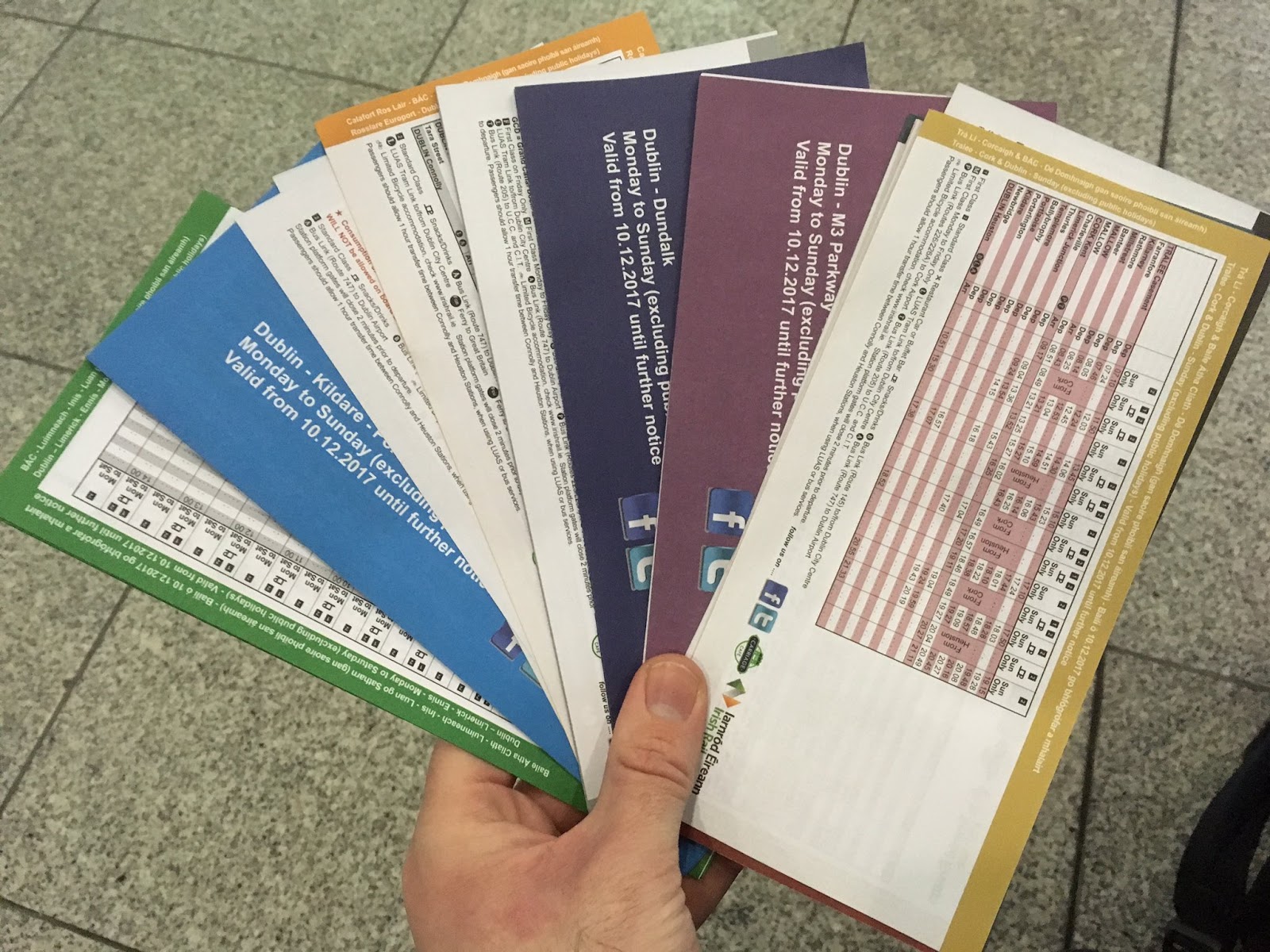

Geoff and I had a first planning meeting in early 2018, with the intention of it happening later that year. Although we stretched the plan to about two weeks, it was still fundamentally following the same order as my five-day plan, starting in Rosslare and finishing in Derry/Londonderry, going round the lines out of Dublin in a roughly clockwise fashion, and using a bus between Ballina and Sligo to save a very long back-track.

However, in the end, due to other commitments, it didn't happen in 2018, but instead ended up pushed back to Easter 2019. In the meantime the plan was refined and extended a little, but I'm delighted that the plan ended up working almost without a hitch! It looked like Brexit could end up complicating matters, but an extension to the Article 50 negotiating deadline meant that didn't matter in the end.

Geoff and Vicki departed from London on the night of Thursday 21st March 2019, making their way to Rosslare the following day and then spending two weeks going round the Republic of Ireland. By the time they got back to Dublin on Sunday 7th April, they had just the line from Dublin to Belfast, and all of Northern Ireland, left to cover. Meanwhile, I flew to Belfast on Friday 5th April to stay with my parents for a few days, ready to meet up with Geoff and Vicki in Northern Ireland!

Monday 8th April (Day 15)


For Geoff and Vicki, Day 15 started in Dublin, as they made their way to Belfast. Although the Enterprise runs up to eight times a day between Dublin and Belfast, they of course needed to call at every intermediate station, so they only used the Enterprise between Drogheda and Newry.

My day started in Bangor, from which I caught the 14:57 train to Belfast, and then the 16:05 Enterprise from Belfast to Newry, to meet them there. We had over a two-hour wait for their first train in NI: Northern Ireland's two most awkward stations are Scarva and Poyntzpass, between Newry and Portadown. While Newry is served by the Enterprise service between Belfast and Dublin, the rest of the suburban services usually only go as far as Portadown, with just five trains a day extending to call at Poyntzpass and Scarva.

After nipping into the town centre to get a coffee, we boarded the 18:50 train all the way into Belfast. There being plenty of material for the one video already, I didn't appear on camera in the video, but I can assure you I'm sat on the train out of shot! The train was very quiet leaving Newry, and Geoff and Vicki naturally got talking to the guard; what I wasn't expecting was that the guard would make a special announcement welcoming them to NI! That was definitely the most surreal moment of the trip for me.

The trouble with there being so few trains calling at Poyntzpass and Scarva was that it really wasn't hard for the educated enthusiast to work out which train we were on... and even before we arrived into Great Victoria Street in Belfast, a couple of young fans had managed to track down the train and introduced themselves to Geoff and Vicki, with half a dozen more people waiting for their arrival into Great Victoria Street at 19:59, including a family with a young girl who'd made a lovely drawing for Geoff and Vicki!

Eventually, Geoff and Vicki managed to escape to their hotel, and I headed back to Bangor. Saying "See you in Bangor!" to folk who I'm used to seeing in London was... somewhat disorienting...!

Tuesday 9th April (Day 16)


The next morning (Tuesday 9th April) I met Geoff and Vicki at Bangor station just before midday. Unlike the previous day, where I had stayed entirely off-camera, today I was very much on-camera. I'd done videos with Geoff before, but this was somehow different: here I was the third person on camera, not the second. But more than that, it also felt like I was introducing Geoff and Vicki to the place I grew up, almost like I was showing them round.

We started with Geoff interviewing me in the café in Bangor station — which even as I write that seems like a completely surreal concept — with a few questions about the Northern Irish railway network. He started by shaking my hand — only, I was expecting his signature left-handed handshake, and you can just spot on the video that I start to reach out my left hand before realising he isn't holding the camera (Vicki was)!

I'd brought along my copy of Johnson's Atlas and Gazetter of the Railways of Ireland, an absolutely wonderful historical atlas of Ireland's railways, as a prop to talk about how many railways in Ireland had closed in the 1950s and 1960s to leave the shriveled network we have today.


The atlas was a gift from my grandparents some twenty years ago, and I still treasure it. In fact, the first question Geoff asked was about how I'd got into railways in the first place: that was very much down to my grandpa, who was a civil engineer in the Roads Service in Northern Ireland but who passed on his love of all things transport to me. The question and my answer ended up on the cutting room floor, but it relaxed me into the rest of the interview.

After the interview, we split up, with Vicki going to look at the castle, and Geoff and I walking into the town briefly to get a drone shot of the marina (which also ended up on the cutting room floor). We reconvened to get the 12:27 train to Cultra, on which I described to camera what all we were going to do that day — and in so doing I managed to steal Vicki's thunder by doing what she normally did!

We stopped off at Cultra to head to the Ulster Transport Museum — co-located with the Folk Museum and thus generally advertised as the Ulster Folk and Transport Museum (which I must confess paints a very schizophrenic picture until you realise they're separate!) — where we spent an hour looking round. This was very much a trip down memory lane for me: a trip with my grandparents from Bangor to Cultra to visit the Transport Museum was probably one of my first, if not my first ever, train trip. Although I visited the museum several times as a child, including one or two school trips, it must have been at least 15 years since my last visit.

An hour after we arrived, we were back on the train heading to Belfast Central — or rather Belfast Lanyon Place, it having been renamed seven months previously. The name "Central" stems from the Belfast Central Railway, on which the station lies, rather than the station's location within Belfast: the station is in fact at the eastern edge of the city centre, with Great Victoria Street being much closer to the city centre. While the renaming is welcome, "Lanyon Place" is hardly the kind of memorable name that is likely to displace "Central" in the public consciousness; something more straightforward like "Laganside" would have been better in my view!

The line from Cultra to Belfast runs largely along the south shore of Belfast Lough; after changing at Central (sorry, but old habits die hard!), we headed back out along the opposite shore on the 14:25 train out to Whitehead. I'd not been on this line in many, many years, and I'd forgotten how lovely the views are across to Holywood and Bangor. We passed by the iconic Carrickfergus Castle, but unfortunately there wasn't enough time in the plans to stop for a visit. Vicki was very disappointed. (The drone shot seen in the video, incidentally, was actually filmed a couple of days later.)

Upon arrival at Whitehead at 15:00, we were met by Robin from the Railway Preservation Society of Ireland, who whisked us off to the Whitehead Railway Museum. Vicki and I introduced ourselves to Robin while Geoff went and got a few extra shots; I explained I was the local (even if I haven't lived in NI for many years), and Robin immediately replied "ah, you're the fixer!" In the video, Geoff described me exactly like that as he pulled into Bangor, but that was before I'd seen either of them, so this was my first time hearing myself described like that!

The RPSI works have been based at Whitehead since 1964, but the museum was brand-new, having opened in 2017, and I'd never been, so I was really quite excited to see round. The museum only usually opens on Thursdays, Fridays and Saturdays, but the folks at the museum had heard Geoff and Vicki were coming, so opened the museum especially for us to look round!

We quickly realised there was lots to see, more than we'd bargained for. As a result, Geoff and Vicki decided quickly that the Whitehead museum deserved its own bonus video, rather than just being a snippet in an already busy day's video, so they quickly filmed a piece to camera to act as a teaser for the bonus video. Robin then showed us round as much of the museum as we could see in about an hour — although we'd planned to get the 16:01 train to Larne, we quickly realised the 16:35 made more sense, and re-planned accordingly.

The guys at the museum were wonderful, and even though we had very little time there we got to see a fantastic amount of stuff, including a working signal box where Vicki and I both got to pull some real old-fashioned levers. Robin even gave us a lift between the station and the museum, even though it was only a 10-minute walk, to make sure we could see as much as possible — many thanks to the whole team for pulling out all the stops on the day.


A couple of the young lads from the museum joined us on the train onwards to Larne, which has some lovely views over Larne Lough that I'd forgotten all about. Once we got to Larne Harbour, at the end of the line, they headed straight back, while the three of us got off and took a quick look round. The station was, as you'd expect, deserted, there being no ferries in the harbour and little other reason to use the Harbour station over Larne Town.

Geoff and Vicki filmed the closing segment to the video outside the station, and then we headed back to Belfast on the 17:35 train. Our earlier re-planning worked out quite well, in that we ended up only having to spend half an hour in Larne Harbour, as well as avoiding the 20-minute walk from Larne Town to Larne Harbour that had been part of the previous plan. The segment where Geoff and Vicki say goodbye to me at the end of the day was actually filmed on the way back to Belfast!

We arrived back into Belfast Central at 18:36; Geoff and Vicki headed to their hotel, while I headed back to Bangor for the night, ready for another day of trains.

Wednesday 10th April (Day 17)


The next morning was the last day of ATS Ireland, and there was only one line left to do: Belfast to Derry/Londonderry, as well as the short branch to Portrush. My day started with the 10:27 from Bangor to Belfast, and I met Vicki at Belfast Central to get the 11:20 to Coleraine.

Geoff, however... off of my suggestion he'd gone to get a drone shot of Bleach Green Viaduct (which you can see in the video). Due to the location, he'd had to get a taxi to and from the viaduct site, and it took a bit of a walk to get the right shot, so he only just made the train at Yorkgate — which is why the video starts there rather than at Central.

In the video you can see me talking about the viaduct, which is part of the reason I actually appeared in the video and wasn't just out-of-shot as I was on Monday. The section from Bleach Green to Antrim was shut in 1978, with trains diverted via Lisburn, but reopened on Sunday 10th June 2001 — and I was a passenger on the very first day, again with my grandparents. According to the commemorative ticket, I was passenger number 162 (my grandparents were number 163 and 164 respectively)!


Unfortunately we were delayed by about 10 minutes at Ballymoney waiting for a late train from Derry/Londonderry to clear the single line — I've previously written about the line to Derry/Londonderry being the busiest single-track railway in the UK, and it showed itself up here — and we started to worry that we might miss our five-minute connection over the footbridge at Coleraine to make the 12:45 to Portrush. But with just one train an hour, NI Railways held the connection — and perhaps as much as half the people on the train streamed over the footbridge to catch the connection out to Portrush.

The station at Portrush was in the middle of being rebuilt, and would fully reopen a couple of months later in time for The Open golf championship, which was hosted by Royal Portrush Golf Club in 2019 for only the second time, the first being in 1951. This provided a huge boost to tourism in the area, but required quite substantial reconstruction of the existing station, which was therefore something of a construction site when we visited.

That said, for Geoff and I the visit was very brief indeed: on arrival at Portrush, we split up, with Vicki going off to explore the seaside town of Portrush. Although I said "goodbye" in the video, this was simply a convenience of the video, and in reality Geoff and I headed straight back to Coleraine on the train we'd just come in on, to go and get a very special shot for later in the video...

Outside Coleraine station we took a taxi to Downhill Strand, Northern Ireland's answer to Dawlish. The railway runs through two tunnels west of Castlerock station, emerging on the beautiful white beach at Downhill — the perfect location for a drone shot of a train. There were very few buses, so we took a taxi; the driver said he hadn't been to Downhill beach in at least a decade. Hilariously, my accent — which has been somewhat anglicised over the years of living in England — reverted and became ever more broad the more I talked to the taxi driver, to the point where even Geoff struggled to understand me at times!

We got out of the taxi and crossed under the railway bridge onto the beach itself, and Geoff got his drone out to take the shot. Sadly, he'd accidentally left it on after getting the shot at Bleach Green, and the battery had run down — all that was left in the batteries was for a brief 30-second flight where it went up and came back down again — so while it was a lovely shot of the beach and Mussenden Temple (the building perched atop the cliff above the railway), it didn't have any trains in it.

Geoff tried to get it to come back to life, but to no avail. With minutes to go until the hourly train passed through, Geoff hit upon the great idea of filming a passing shot from the beach — which you can see in the video. To steady the shot, Geoff rested the camera (tripod and all!) on my shoulder, before panning round to track the train as it passed us heading towards Derry/Londonderry. (Geoff also shot some panning shots of the train coming back the other way a few minutes later, although those weren't needed in the end.) Fortunately the panning shot worked brilliantly, and rescued what could have been a disastrous trip to Downhill.

However, there was then the small matter of Geoff and I meeting up with Vicki again to get the following train to Derry/Londonderry. My original plan had been to walk round the headland to Castlerock, but even at low tide it turned out to be impassible, at least in the shoes we were wearing. So we had to turn back and head back to the car park where the taxi had dropped us off. We thought briefly that we'd have to call another taxi to come and get us, but then Geoff checked the bus timetable online — and found there was a number 134 bus right when we needed it, heading towards Castlerock, that would get us there just five minutes before the train!

We nervously waited in the rather forlorn bus shelter for the bus to come, and I confess I was a little worried it wouldn't show up — but it showed up bang on time, or perhaps even a little early. Because of our iLink cards, we didn't even have to pay extra for the bus, and it got us to Castlerock in plenty of time for the 14:50 train to Derry/Londonderry. We were reunited with Vicki on the train, which took us right past Downhill Strand where Geoff and I had just been — which is perhaps why Vicki is so awed by the beach, whereas Geoff had already seen it!

The video sequence ("What the actual Dickens?!") — complete with specially composed extended music — perfectly captured the sense of wonder I remember feeling the first time I went on a train to Derry/Londonderry as a child, with the beautiful view suddenly emerging from the darkness of the tunnels. I still maintain that the views between Coleraine and Derry/Londonderry are perhaps the best views from a train anywhere in the British Isles; at the very least they give the West Highland Line and the Kyle Line a very good run for their money — and have a much more frequent service!

Our arrival into Derry/Londonderry was bang on time at 15:22; Geoff and Vicki got a number of shots from the platform while I waited off-camera. When they were done a handful of fans were waiting for them — they had worked out which train they were on based on Twitter — and Geoff and Vicki happily posed for selfies once they came off the platform.

After a few more shots of the external of the station — which both Geoff and Vicki took care not to actually name on camera, to avoid even being seen to take sides in the naming dispute! — and of the following train arriving into Derry/Londonderry (as seen from the new Peace Bridge), we boarded the 16:38 back to Belfast, with Geoff and Vicki taking a well-earned nap after 17 days of trains in Ireland.

And that was it: all of Northern Ireland done in less than 48 hours!

The original plan had been written to do the whole island in as short a time as possible, and while the rest of the Ireland plan had been dilated to take a good bit longer and allow plenty of time to stop and see the local sights, the Northern Irish plan remained mostly unaltered from the original 2018 plan.

With hindsight, I suspect Geoff and Vicki could or should have spent longer going round Northern Ireland: perhaps one day for the Bangor branch, one day for the Larne line, and one final day (or possibly even two days) for the line to Derry/Londonderry. That said, given my flight schedules, too much change might have meant I couldn't make it into the videos!

All in all I had a lovely few days in Northern Ireland, in which it felt like I got to show Geoff and Vicki round this wonderful railway network that I'd grown up with, and which I still cherish as one of the hidden railway gems in the UK.

Sunday, 5 April 2020

On This Day: Track-Bashing in Cardiff and London, 6th April 2014

In my quest to travel on every railway line in the UK, some lines were a lot harder than others. There are a number of diversionary routes that see very limited use in normal circumstances, but which retain a token service primarily to enable drivers to retain "route knowledge" over these lines.

One of these sections of track is the Leckwith Loop, just west of Cardiff, circled in red in the map below. This 26-chain (520m) section of track provides an alternative access between Cardiff Central station and the line towards Bridgend, through Ninian Park station rather than along the South Wales Main Line.

Map based on OpenStreetMap; © OpenStreetMap contributors
However, a previous attempt to use one of the small number of services booked over this line had failed — as the train had simply run the "normal" route along the main line. Rather than try again, I waited for a day when the main line was closed for engineering works, so that all trains would be running via the Leckwith Loop.

On Sunday 6th April 2014, such a day finally materialised. But there was a problem: there was another bit of track I needed also in use on the same day, in London!

There were engineering works at Bromley South in south-east London, with the station completely closed. This would have meant Bromley being without a train service; so instead, SouthEastern ran a service to Bromley North, which is usually closed on Sundays.

Bromley North is at the end of a 1 mile, 49 chain (2600m) branch line from Grove Park, which is ordinarily served by a simple shuttle service between Grove Park and Bromley North, running every 20 minutes on Mondays to Saturdays, with no Sunday service. (See map below.)

Map based on OpenStreetMap; © OpenStreetMap contributors
However, on this Sunday, through trains were running from London Victoria, meaning that the connection at Grove Park onto the branch — never normally used in passenger service — was being used all day! The bit of track that I wanted to travel on was perhaps less than 100m long — but it was rare enough to be worth the journey.

So, I hatched a plan. From home in Coventry, I needed to go at least as far as Bridgend to cover the Leckwith Loop, and I needed then to go to London to get to Bromley North. Coming up with a plan for the journeys was fairly straightforward, but figuring out which tickets to use was much more difficult; three singles would have been prohibitively expensive.

A bit of digging into the fares system found that Coventry to Bridgend had two available ticket routes: via Birmingham or via Reading, with the former being the cheaper (as it was a shorter route). If I went out via Birmingham and came back via Reading, then all I would need on top of that would be a Reading to London ticket, and problem solved.

So, to do this, I wanted a Coventry to Bridgend return, routed via Birmingham, with the return portion excessed to come back via Reading... which is where the trouble started. Because it was a slightly complicated ticket, I deliberately went the previous day to the ticket office in Coventry to buy it, only to be told that excesses could only be done on the day of travel. So I purchased the main return ticket, and came back the following morning in plenty of time.

Then a second problem appeared: while the cheapest fare via Birmingham is the Off-Peak Return, the cheapest via Reading is a Super Off-Peak Return. At first the ticket office tried to insist I had to excess my Off-Peak to another Off-Peak, but I pointed out the wording of the National Rail Conditions of Travel:
"If you make a journey by a route that is not valid you will be liable to pay an excess fare. The price for this will be the difference between the amount paid for the Ticket you hold and the lowest price Ticket available for immediate travel that would have entitled you to travel by that route."
Eventually, after the two clerks talked to a supervisor, they agreed to excess it to a Super Off-Peak Return. However, they weren't able to only excess one portion (perhaps due to a limitation of their IT systems) — so I had to excess both outward and return portions. The internal guidance to railway staff states that it is possible to only excess one portion, and that that should be charged at half the difference; but since that guidance isn't made publically available, I couldn't rely on it.

In the end, then, I had these four tickets (as well as a Reading to London Travelcard):


The one in the bottom-left wasn't necessary, so I paid perhaps £7.30 more than necessary, but I accepted that as a price for getting on the train I needed to get!

0837 Coventry to Birmingham New St, arr 0906
Headcode: 2C99, operated by London Midland using Desiro 350129*+350104
Distance: 19 miles

My Sunday morning started with the first departure from Coventry: all lines through Coventry are shut on Saturday nights to enable essential maintenance work to be undertaken, meaning the first train doesn't leave until after 08:30. This was an uneventful run, calling all stations to Marston Green and then running fast to Birmingham New Street, where I had a six-minute change:

0912 Birmingham New St to Newport, arr 1055
Headcode: 1V46, operated by CrossCountry using Voyager 220011
Distance: 97¾ miles

Owing to engineering works between Bristol Parkway and Swindon, this 09:12 to Plymouth was diverted via Newport — yes, a train that should have run entirely within England was diverted via Wales. This was great news for me, though, as it saved me an hour, as otherwise I couldn't have got to Newport so early — one of those wonderful unusual moments where diversions worked in my favour!

We left Birmingham by the usual route through University, running non-stop to Cheltenham as usual. But after that, we turned right to head to Gloucester, and carried on down the lovely route along the Severn Estuary, with lovely views of the Severn Bridge (M48) and the Second Severn Crossing (M4) from Chepstow, livening up an otherwise dull, grey day.

Although some of the diverted trains were reversing at Severn Tunnel Junction to head back through the Severn Tunnel and head onwards to Bristol, this involved reversing beyond the station, and where possible it is preferable to do so in a platform. Our train therefore continued another 9 miles to reverse in Newport, the next station, where we arrived three minutes early thanks to the generous timings for these engineering diversions.

1100 Newport to Bridgend, arr 1140
Headcode: 1B14, operated by Arriva Trains Wales using Sprinter 150236
Distance: 33¼ miles

At Newport, I changed onto a two-car Sprinter forming the 1009 from Hereford all the way to Fishguard Harbour — fortunately I was only going two stops to Bridgend! The train was a bit late coming in from Hereford — perhaps due to the CrossCountry services reversing at Newport and getting in the way — and eventually left about five minutes late.

Once we got to Cardiff, I poked my head out of the door to look at the signal, and was delighted to see the box above the green signal saying "N" — indicating we'd been cleared for the route towards Ninian Park — and not "M" for main line. Even with the engineering works going on, I was still in a little doubt as to whether this diversion would come off — but it did, and it was suddenly worth the journey!

We left Platform 3 at Cardiff Central on what was then called the Down Barry Relief line — but instead of heading towards Barry we peeled off right to go through Ninian Park station. Due to the track layout here, we passed through the Cardiff-bound platform in the "wrong" direction — though since Ninian Park doesn't get a Sunday service there weren't any passengers to be confused!

And then we turned onto the Leckwith Loop, a 26-chain (520m) section of track which had been the entire purpose for my journey to Bridgend. I wish I could say the track afforded some spectacular view, but the only view on offer was that of suburban Cardiff. After an all too brief minute or so, we rejoined the South Wales Main Line at Leckwith North Junction, and carried on along the normal route to Bridgend along the South Wales Main Line.

I arrived in Bridgend and crossed smartly to the other platform, to head straight back to London:

1153 (actual 1159) Bridgend to London Paddington, arr 1551 (actual 1542)
Headcode: 1L54, operated by First Great Western using HST set OC47 with 43093+43124
Distance: 183¾ miles

Due to the aforementioned engineering works between Bristol Parkway and Swindon, this train was taking the long way round to London — in more ways than one — turning a journey that should have taken 2 hours and 50 minutes into a 4-hour marathon. As a treat to myself, and since the train was expected to be fairly busy, I elected to pay the £20 for a first-class upgrade, which got me some snacks and a decent seat with a view for this long trip.

Here's a map showing the usual route (in blue), and our diversion (in orange):

Map based on OpenStreetMap; © OpenStreetMap contributors
We left about six minutes late, and retraced our steps to Cardiff, again travelling via the Leckwith Loop and continued through Ninian Park station. Since the Leckwith Loop is only a single-track chord, this didn't produce any new track for me, but it did mean use of the crossover at Leckwith North Junction. We then approached Cardiff Central on the Up Barry Relief, before crossing the ladder at the west end of the station to gain access to Platform 1.

From Cardiff Central we departed and proceeded as normal to call at Newport, and then carried on through the Severn Tunnel to Bristol Parkway. Since the route onwards towards Swindon was shut, after a 6-minute stop we reversed direction to head down Filton Bank (which was still two-track back then!) to Bristol Temple Meads.

After a 13-minute stop at Bristol Temple Meads we reversed direction again to call at Bath Spa. But even the normal route onwards from Bath Spa was blocked, so we deviated right at Bathampton Junction to head through Bradford-on-Avon and Trowbridge towards Westbury.

Just before Westbury, at Hawkeridge Junction, we peeled off onto the Westbury East Loop — allowing us to head towards London without having to reverse once more in Westbury station — and joined the "Berks and Hants" route into London, through Newbury. Although I'd done the Westbury East Loop before, it was always nice to do such an unusual piece of track again — like the Leckwith Loop, it gets a handful of services a day, so it's much easier to do it during engineering works.

We carried on to Reading, where we arrived on time; however, due to even more engineering works, only two of the four tracks between London and Reading were open, so we crossed to the Up Relief east of Reading to crawl along the lines usually used by stopping trains. We ran quite early, so much so that we were held at Heathrow Airport Junction for six minutes awaiting a train from Heathrow to go in front of us.

Once we got to Ladbroke Grove, where the four-track main line widens out into six tracks for the final approach to Paddington, we crossed unusually all the way across from Line 6 to Line 1 — enabling us to arrive into Platform 4 at Paddington a full nine minutes early at 15:42.

I hot-footed it to the tube to head onwards to Victoria:

Bakerloo Line: 1545 Paddington to Oxford Circus, arr 1553
Victoria Line: 1554 Oxford Circus to Victoria, arr 1558

Thanks to a very efficient cross-platform interchange at Oxford Circus, I arrived in Victoria only 16 minutes after I arrived in Paddington, very good going indeed! I recall the Bromley North service was running half-hourly, but I'd already had a long day and I was glad to be able to speed along onto my train to Bromley North:

1608 London Victoria to Bromley North, arr 1642
Headcode: 2U40, operated by Southeastern using Networker 465016
Distance: 12¼ miles

To get to Bromley North from Victoria required almost as much of a magical mystery tour through South London as I had just had through Wiltshire and Berkshire! We departed on time from Platform 6 at Victoria, initially on the Down Chatham Slow, but crossing to the Down Chatham Fast at Grosvenor Bridge Junction. From there we carried on to Brixton Junction, where we turned left to run via the Catford Loop through Denmark Hill — another slightly unusual piece of track to be using.

We called at Denmark Hill, Peckham Rye and Nunhead before turning left at Nunhead Junction to head towards Lewisham. But instead of using Platform 4 at Lewisham, as most trains from Victoria would, we used Platform 2, in order to head down the main line from Charing Cross through Hither Green.

Just outside Grove Park, we crossed from the Down Slow all the way over to the branch platform (Platform 1), using the very unusual connection onto the branch — and when I say unusual, I mean it doesn't have any booked passenger services! On the one hand, this meant I didn't technically need to do it, as it didn't count as a line with a regularly-scheduled passenger service; but on the other hand, getting a passenger train over a bit of track that isn't normally used is pretty cool, no?

After a minute or two stopped in the branch platform, we continued onwards to Bromley North — and although I didn't need to do the connection, I did need to do the branch itself, which I hadn't. However, while they'd opened Bromley North station specially on this Sunday to provide a service to the people of Bromley, they didn't bother doing the same for the one intermediate station on the branch at Sundridge Park — so, even more unusually, we sailed non-stop through the station!

Arrival into Platform 2 at Bromley North was bang on time, at 16:42. By this stage the dull greyness had given way to drizzle, and rather than try and do anything clever I simply returned to the train to head back into Victoria:

1655 Bromley North to London Victoria, arr 1726
Headcode: 2U90, operated by Southeastern using Networker 465016
Distance: 12¼ miles

After stopping at Grove Park platform 1, we crossed to the Up Slow to retrace our steps to Victoria, getting held briefly at Nunhead Junction for a train crossing our path. This brief delay meant we arrived into Victoria three minutes late at 17:29. By this stage I was quite hungry and grabbed some food to eat on the way home, before heading back to the tube and back to Paddington:

Victoria Line: 1744 Victoria to Oxford Circus, arr 1748
Bakerloo Line: 1751 Oxford Circus to Paddington, arr 1759

Another cross-platform interchange at Oxford Circus, though the frequency on the Bakerloo line meant it wasn't quite as efficient as the previous one. Although I was heading back to Coventry, and the fastest route to do so would have been to head to Euston, because of the combination of tickets I'd used I had to go back via Reading, which meant leaving once more from Paddington:

1815 London Paddington to Reading, arr 1911
Headcode: 2R63, operated by First Great Western using Turbo 165109*+165131
Distance: 36 miles

We left from Platform 13 at Paddington, one of the former Metropolitan Railway platforms converted for use by mainline trains, which has now disappeared: in order to lengthen Platform 12, Platform 13 had to go (or rather, Platforms 12 and 13 were effectively merged).

Since I had to head back to Reading anyway, I elected to take a stopping train — as this gave a useful opportunity for a friend of mine in West Drayton to lend me a high-visibility jacket, which I needed for the following weekend. He duly met me on the platform and handed the orange jacket off through the train door, and I carried on to Reading without delay. (Possibly more of that story soon!)

I knew that the CrossCountry trains from Reading to Coventry were only every hour, and I knew that I would likely just miss one, it being due out just two minutes before we arrived. However, I also knew that CrossCountry trains — by their nature of crossing the country — have a tendency to be late... as we were pulling in, I checked my phone and saw that the 19:09 hadn't left yet, so upon arriving at Platform 13 at Reading I ran up onto the huge brand-new footbridge and over to Platform 8...

1909 (actual 1912) Reading to Coventry, arr 2023
Headcode: 1M70, operated by CrossCountry using Voyager 220001
Distance: 79¾ miles

Made it, just! We left just 90 seconds after I'd arrived at Reading. The rest of the journey home to Coventry was an uneventful journey on a familiar route: the only oddity being that we were routed through Didcot Parkway station (via Platform 3) without stopping, instead of going round the avoiding lines; this is sometimes done to avoid a conflict, although it does slow the train down a little bit.

Nearly 12 hours after I left, I arrived back into Coventry just a minute late, after a very successful 474-mile day... of which perhaps 4 miles were new track — such is the life of track-bashing!

Sunday, 29 March 2020

On This Day: Diversions During the Reading Blockade, Easter 2013

Since we're all locked down due to the current pandemic, and I therefore can't indulge my hobby of going on trains for a fun weekend, I thought it might help everyone if I looked back at some of the many, many trips I've taken but never written about. So, welcome to the revival of my blog!

Today's trip is from seven years ago today: Friday 29th March 2013, which was Good Friday. Due to the massive remodelling of Reading station, First Great Western trains were subject to some incredible diversions — so some friends and I took a trip to Paignton and back to sample the diversions.

I think it's worth taking a moment to remember how transformational a project the Reading remodelling was: adding five new full-length platforms (while closing two short bay platforms), but more importantly grade-separating most of the conflicting movements to the west of the station with the incredible flyover structure installed.

For comparison, here's the 2009 track layout:


And the 2015 track layout:


Obviously to get from one to the other took a lot of work, and one big chunk of that was done over the four-day bank holiday weekend at Easter 2013, which saw Reading shut to all but a handful of trains. The main job at Easter 2013 was to open platforms 12-15 and to slue the Relief Lines (shown above in green) to the north to create the space to build the rest of the new layout to the west of the station.

However, with Reading shut, there's not an obvious way to get trains from the Westcountry and South Wales into London. But not running any trains would simply have left hundreds, maybe thousands of people trying to wait for dreaded rail replacement buses. This simply wasn't acceptable.

Instead, some very commendable long-term planning on the part of First Great Western and Network Rail ensured that an hourly service between London and each of Bristol, Cardiff and Plymouth could be maintained throughout the block, using a variety of fascinating diversionary routes, shown in the map below.

Map based on OpenStreetMap; © OpenStreetMap contributors
The orange lines through Reading were shut for through trains for the whole weekend. Instead, trains to Bristol and Cardiff used the diversionary route into London Paddington via Banbury shown in green, while trains to Exeter and onwards to Plymouth and Penzance used route shown in blue into and out of London Waterloo!

Both routes were incredibly rare territory for HSTs to use, especially the route into Waterloo. So my friends and I hatched a plan to go to Paignton and back, going out from Waterloo via Basingstoke, and coming back via Bristol and Banbury into Paddington.

As I was living in Coventry at the time, my day started with a Pendolino from Coventry to London Euston:

0811 Coventry to London Euston, arr 0913 (actual 0924)
Headcode: 1R21, operated by Virgin Trains using Pendolino 390154

Oddly, even though it was a bank holiday, Virgin Trains were running more or less a full weekday service, complete with extra peak trains. Needless to say my train was pretty empty.

Unfortunately we were held at Rugby for seven minutes to allow the late-running 04:28 from Glasgow Central to pass us. We lost a bit more time en route and eventually arrived into Euston 11 minutes late, meaning I had to hot-foot it to Waterloo:

Northern Line: 0928 Euston to Waterloo, arr 0937

By the time I arrived the others were already on the platform for the FGW train to Penzance:

0959 London Waterloo to Newton Abbot, arr 1352
Headcode: 1V36, operated by First Great Western using HST 43168+43040

The train was fully reserved in standard class, so we walked to the far end of the train and took up a bay of seats in first class - £20 for the upgrade was more than worth it for the four-hour trip to Newton Abbot. Because the diversion entails a reversal en route, the train had first class at the country end, not the usual London end, so we had quite a trek to the far end of platform 11 to board our train.

For some bizarre reason, although the FGW HSTs were booked to leave Waterloo at xx:07 — sandwiched between the xx:05 to Weymouth and the xx:09 to Poole — they were advertised as departing eight minutes earlier. The train was advertised to depart at 09:59 — although the automated announcements at Waterloo didn't have all the stations to Penzance recorded, so the announcements had some hilarious gaps in them — but we actually pulled out at 10:07.

On previous occasions, HST diversions into Waterloo had been limited to the Windsor side, either direct from Reading via Waterloo, or from Woking via Chertsey. As I recall, this was the first time HSTs had been allowed to run along the South Western Main Line all the way up through Surbiton and Wimbledon.

We were booked non-stop from Waterloo to Basingstoke, getting a pretty decent run at 42 minutes start-to-stop — only a couple of minutes longer than a non-stop run on (then) South West Trains. One of our friends was busy and couldn't make it, so a couple of our party decided to bellow out the droplights as we went through his station — though I'm not sure the good people of SW19 were expecting to hear "GOOD MORNING, WIMBLEDON" from a passing HST!

After our stop at Basingstoke we continued towards Salisbury, getting checked briefly outside Salisbury station, before carrying on through Warminster and into Westbury. At this point we rejoined territory much more familiar for FGW HSTs, but in order to do so the driver had to change ends — the lines to Salisbury and Taunton face the same way out of Westbury. The reversal put first class into the more normal position at the back end of the train.

After the reversal, which took all of five minutes, we carried on — still bang on time — round the Frome avoiding lines, to Castle Cary, where we had a long 9-minute stand in order to regain some semblance of a "normal" path — presumably the fact that Westbury only has three platforms prevented us from dwelling there any longer.

We carried on, calling at Taunton and Tiverton Parkway, and into Exeter St David's, where we again had a long booked stand, this time of 17 minutes. This would probably have been done in order to keep most of the local service around Exeter — the lines to Barnstaple, Exmouth and Paignton — running to a relatively standard timetable.

The last leg of our journey took us down the wonderful stretch past the sea wall at Dawlish, and onwards to our arrival at Newton Abbot at 13:52, bang on time.

Unfortunately, our connecting train to Paignton was not on time; it was coming the other way, via Banbury and then via Bristol — and there had been a problem between Banbury and Oxford with a previous train, making our train just over an hour late. The original plan of having about 45 minutes in Paignton was thus scuppered, as our train was in fact going to be terminated at Newton Abbot. More significantly, this meant our train back to London was going to start from Newton Abbot.

However, while I'd previously been to Torquay some years previously, I'd never done the last bit of track from Torquay to Paignton — so I all but insisted that we get another train to Paignton and back, even if it only gave us about 10 minutes in the town. We wandered into the small town of Newton Abbot to find some lunch — I think we ended up with fish and chips — and then back to the station.

1441 Newton Abbot to Paignton, arr 1500
Headcode: 2T19, operated by First Great Western using Pacer 143603
and
1513 Paignton to Newton Abbot, arr 1529
Headcode: 2F41, operated by First Great Western using Pacer 143603

We took a Pacer to Paignton and came straight back, barely even stepping onto the platform, but at least the original aim of getting to Paignton was fulfilled. The train was fairly busy with families going to and from the seaside on a chilly but not unpleasant Good Friday. Of course, Pacers don't have first class, so we had to suffer standard class with the rest of the travelling public...

We changed at Newton Abbot once more, crossing the footbridge to our train, which was just arriving an hour later than it should have been, to head back to London.

1549 Newton Abbot to London Paddington, arr 2025
Headcode: 1A27, operated by First Great Western using HST 43010+43182

Once again, we paid the £20 upgrade to sit in first class, as this journey was nearly 5 hours long, taking an even longer route to get back to London. We retraced our steps as far as Taunton, though this time calling at Teignmouth and Dawlish, with a longer-than-usual stop at Teignmouth putting us a few minutes late, but we were back on time by Taunton.

After Taunton, we turned left at Cogload Junction instead of right, and carried on towards Bristol instead of Westbury. We called at Weston-super-Mare, which involved going on the loop through the station instead of round the (much faster) avoiding lines — which was track I hadn't been on until that day, so I was very pleased to finally do that bit of track!

From Weston we carried on to Bristol Temple Meads, calling in platform 7 before carrying on to call at Bath Spa, Chippenham and Swindon. So far, so normal for a train to Paddington... but it was about to get decidedly weird.

We continued up the Great Western Main Line towards Didcot, but just before Didcot we turned left — at Foxhall Junction — to take the Didcot West Curve, a piece of track making up the third side of the triangle at Didcot, which normally gets very few passenger trains. It briefly saw a regular service in the early 2000s, when FGW tried running direct trains between Bristol and Oxford, but they never took off.

(Actually, until recently the last CrossCountry train from Reading to Birmingham ran via Foxhall Junction to reverse there and use the Didcot West Curve — for route knowledge retention purposes — and by coincidence I'd been on exactly that train three days previously, after an evening ticking off the old connection between the main part of Reading station and the "Southern" lines towards Wokingham... but that's another story.)

So to get to go round the Didcot West Curve (just before sunset) was great fun, and a bizarre bit of track to be doing on a train from Newton Abbot to Paddington. We kept going to Oxford, which was our last passenger stop before London Paddington, before continuing north.

The train then carried on northwards to Banbury, where we reversed — and in order to allow the reversal to take place, two brand-new semaphore signals had been installed! There had long been shunt signals to allow reversals to take place, but these are not generally allowed to be used by passenger trains, so they were replaced with brand-new signals, complete with finials (the decorative pointy caps on top of the signal post).

From Banbury we then retraced our steps back to Aynho Junction, turning left there and heading through Bicester North and up the Chiltern route towards London. (Now, you may ask why we didn't use the direct line from Oxford to Bicester to save the faff of reversing at Banbury. The answer is that back in 2013, the line from Oxford to Bicester Town was just a branch line, with the Bicester south chord not having been built — so reversal at Banbury was the only option.)

We carried on through Princes Risborough, High Wycombe and Gerrards Cross — all most unusual places for a FGW HST to be passing through! — before getting to West Ruislip. If we carried on we would have ended up at London Marylebone, so instead here we crossed over, to head south on the northbound track as far as South Ruislip, in order to gain the single line towards Greenford.

The line from South Ruislip to Greenford and onwards to Old Oak Common is the remants of the New North Main Line: the Chiltern route was originally a joint venture between the Great Western Railway and the Great Central Railway, to provide them both with a faster route to Birmingham.

However, the connection to Paddington fell into disuse from the 1990s, when services towards Birmingham were concentrated on London Marylebone. A single Chiltern Railways train per day was retained between London Paddington and West Ruislip to keep up route knowledge. But even that ceased to run in December 2018, when the route between Old Oak Common and Greenford was required to close for conversion to use by HS2, meaning that the Chiltern service now only runs between West Ealing and West Ruislip.

So to have a FGW HST running along this stretch of the New North Main Line, while incredibly rare, was a sort-of tribute to a bygone age of express trains from Paddington to Birmingham (and on to Birkenhead!), and the unusual track made for a very enjoyable end to a long day.

We'd made good time en route; although we'd left Banbury about 7 minutes late, the timings through Greenford had a bit of slack in them (a sensible precaution when trying to run four trains per hour over a single-track line), so we arrived into Paddington platform 8 four minutes early at 20:21.

The five of us went our separate ways, and I grabbed a bite to eat (I think I may have gone to McDonalds, but I don't remember all that well now!) before heading for the tube to Euston:

Bakerloo Line: 2046 Paddington to Oxford Circus, arr 2054
Victoria Line: 2056 Oxford Circus to Euston, arr 2058

I opted for the double-back at Oxford Circus, this being a little bit faster than the Circle Line — and I'm glad I did, as I made a train back to Coventry with just a minute to spare:

2103 London Euston to Coventry, arr 2206
Headcode: 1G46, operated by Virgin Trains using Pendolino 390154

By sheer coincidence, I ended up on the same Pendolino that I'd had that morning! The run back to Coventry was much less eventful than the morning run, and I arrived back on time to complete a 673¼-mile day, and one of my longest-ever days on trains.

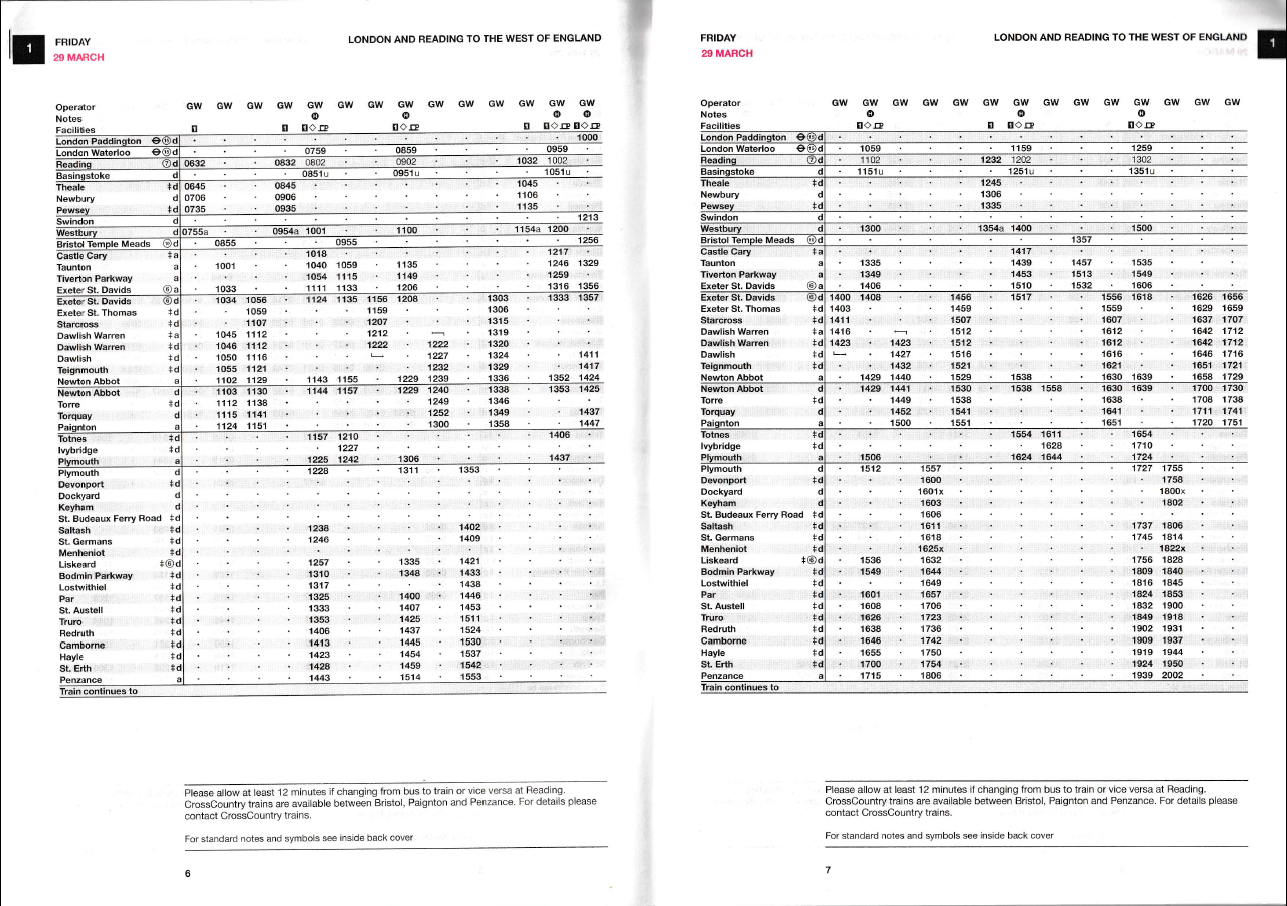
I recently discovered that I'd managed to save some paper timetables from the day — such was the extent of the works that FGW deemed it worth producing hefty booklets showing all the trains on their diversionary routes (though an hilarious misprint meant "Taunton" was printed instead of "Truro" on the front cover!).


The dates on the cover tell another story: although the full block at Reading was only four days, there then followed a week of a very temporary weekday timetable, with only half of Reading station open, while they tied the remaining tracks back together.

That temporary timetable did not go very well: the timetabling was a bit too optimistic, and coupled with a slightly late completion of the engineering works, Easter Tuesday did not go well for FGW. A few hasty changes were made to the timetable for the rest of the week.

But, after another all-line block on the following Sunday to complete the works, the station reopened in full the following Monday (8th April) and settled down to work in a temporary configuration for a couple of years, while the flyover was being built.

Two years later, another all-line block at Easter 2015 was undertaken, with similar diversions, to complete the work at Reading and bring the flyover into use. (I confess that I'd enjoyed the 2013 diversions so much that I did it that I took a trip to Taunton and back in 2015 to experience it all over again — though that trip I did the other way round!)

Ever since, Reading has gone from being one of the worst-performing stations, causing delay to almost every passenger who passed through, to one of the best-performing stations in the country — a testament to a vision for change on the railways.

I hope to write more of these blogs in the future to keep us all sane during lockdown — let me know if there's any particular areas of the country from which you'd like to hear about my travels!

Monday, 21 September 2015

A Scottish Success Story: Reopening the Borders Railway

On Sunday 6th September 2015, a six-carriage train left the new station of Tweedbank at 08:45, bound for Edinburgh: for the first time in 46 years, trains had returned to the Scottish Borders. The Borders Railway, running for over 30 miles from the outskirts of Edinburgh to just beyond Galashiels to the small town of Tweedbank, is the biggest railway reopening project ever undertaken in Britain.

The scene could hardly be more different than 46 years previously: when, on Sunday 5th January 1969, the overnight sleeper train to St Pancras pulled out of Edinburgh Waverley station at 21:56 and headed for Carlisle via Galashiels and Hawick, its path through the Borders was blocked by numerous protesters, and only after the local MP David Steel (who was on the train) intervened was the train able to proceed.

Its eventual arrival in Carlisle, over two hours late, ended over a century of service on the Waverley Route, a 98-mile railway passing through the heart of the Scottish Borders. After years of protests, the line fell victim to the infamous Beeching Axe, with services withdrawn and some of the rails removed the very next day to symbolise the fact that the line was now closed.

To leave such a wide area as the Scottish Borders without railway lines was one of the most controversial railway closures of the 1960s, not least because the railways in the Scottish Highlands serving far fewer people were kept open as a "lifeline". Even until its closure the Waverley Route had carried not just local trains but express trains to and from London, and its closure had a severe effect on the local economy.

The Waverley Route opened from Edinburgh through Galashiels to Hawick in 1849, and was extended to the border city of Carlisle in 1862. Initially it served mainly local traffic, but after the opening of the Settle-Carlisle railway in 1876, the line was upgraded to carry the Midland Railway's express trains between St Pancras and Edinburgh.

The stretch north of Carlisle was one of the toughest sections of mainline for drivers to work, with two summits at Falahill and Whitrope requiring 10-mile ascents at a gradient of 1 in 70. Combined with the many curves, this meant the Waverley Route was comparatively slow, and the Midland Railway could not compete with its rivals on the West and East Coast Main Lines on journey time between London and Edinburgh.

Instead, the Midland laid on plusher coaches in an attempt to give the passenger a better experience. But plusher coaches couldn't make up for the simple fact that the Waverley Route was really a rural line, with no significant base of population along the route; Galashiels is the largest town, but even today it has just 22,500 people.

In the era of rationalisation in the 1960s, then, the fact that there were two routes from Edinburgh to Carlisle was seen as duplication. The other line from Edinburgh served even fewer centres of population than the Waverley Route, but at Carstairs it joined the WCML, and it could thus be worked as a 28-mile branch line off the mainline to Glasgow. It was also straighter and not as steeply graded, with just the one major summit at Beattock to climb.

With the local passenger services used by less than 10,000 passengers a week, and through traffic able to be accommodated on other lines, British Rail saw little reason to keep the Waverley Route open. Closure was initially proposed in the Beeching Report in 1963; the ultimately unsuccessful campaign to keep it open delayed closure until 1969, making it one of the last major closures. It was also one of the longest lines to be closed, second only to the Great Central Main Line, which closed a few months later.

Almost as soon as the line had closed, people campaigned for the Waverley Route to be re-opened. The first serious study was undertaken in the early 1990s, but the key political change that made the reopening possible was Scottish devolution. With power devolved from Westminster to Holyrood, no longer could the plight of the Borders be ignored as simply a rural area remote from London; here was a significant part of Scotland, with an immense potential for tourism, and an obvious candidate for reopening the railway.

With the area looking mainly towards Edinburgh, reopening the line from Edinburgh as far as Galashiels was a logical first step, with extensions onwards to Hawick (and perhaps even Carlisle) left as future possibilities. After much campaigning, in 2006 the Scottish Parliament approved the construction of the line from Edinburgh to a couple of miles beyond Galashiels, to the small town of Tweedbank, with the aim of Tweedbank being a railhead for the wider area.

The line's construction was eventually costed at £294 million for a mainly single-track line with "dynamic loops", sections of double track a few miles long spaced to allow trains to pass at speed. The plans originally called for the 35-mile line to have 16 miles of double track, but this was reduced to just nine miles in order to cut costs and keep within the original budget.

Although the line was originally built as double track, since closure a number of its bridges and tunnels had fallen into disrepair and required replacement prior to the reopening. In order to keep costs to a minimum, a number of the bridges were constructed to allow only a single track - meaning that if the line is to be fully redoubled in future the bridges will need to be rebuilt. Nonetheless, passive provision has been built in for an additional loop through Newtongrange station.

Just seven new stations were opened with the line, the stations at Brunstane and Newcraighall having been opened in 2002 to provide a park-and-ride service into Edinburgh city centre. Four of the seven new stations, Shawfair, Eskbank, Newtongrange and Gorebridge, are in Midlothian, firmly aimed at commuters into Edinburgh. As a result, much of the benefit of the so-called Borders Railway will be felt not by the Borders but by Edinburgh itself, as commuters switch from car to train.

Nonetheless, the three other stations, at Stow, Galashiels and Tweedbank, are right in the heart of the Borders: they will serve not just the town of Galashiels but also Melrose, Newtown St Boswells, and even Hawick. While there are undoubtedly those who commute from Galashiels and around into Edinburgh, whose journeys will be much improved, Galashiels will generate traffic in its own right, with visitors to the Borders finally able to get there by train.

Indeed, just a few days after it opened, I was one of those visitors: on Thursday 10th September I took a trip from Edinburgh to Tweedbank and back. Unfortunately, not everything went as smoothly as could be hoped: the train I went for was eventually cancelled due to an engine problem, and I thus experienced first-hand the fact that, with a single-track railway built down to a price, one significant delay could ripple through the entire service.

There are precisely enough passing places on the single-track line to support a half-hourly service, and no more. (This must be one of the few railways that is being used at 100% capacity immediately after opening!) The fact that the loops are "dynamic" means trains can pass at speed, and with the loops being a few miles long there is scope to recover from delays of a few minutes, but not much more.

I had arrived in Edinburgh from London at about 16:15, and I walked over to get the 16:24 to Tweedbank from platform 7. The train was already pretty full, and I was lucky to get a seat - but given this was the last train on which off-peak tickets were valid until the 18:24 departure this was no great surprise. But 16:24 came and went; the crew for the train had been delayed, and by the time they got there at 16:35 or so, the engine had automatically shut down. The driver tried to restart the engine, but it spluttered and spluttered, sounding distinctly unhealthy.

Eventually, after ten minutes or so, the guard announced the train was cancelled, and that passengers should join the next departure, the 16:50, from platform 20. Those of you who know Edinburgh station will know that platform 7 to platform 20 is one of the longest walks you can have to do in Edinburgh station! But I only got just back towards the concourse before I heard: "This is a platform alteration: the 16:50 Scotrail service to Tweedbank will now depart from platform 7."

Everyone was rather confused, but it eventually became obvious what was going to happen: the 16:50 would come in to platform 7 and join up to the sickly 16:24, and the pair of units would go up to Tweedbank as one. Unfortunately, by the time the driver was informed of this, and by the time the trains were actually joined together, the train departed Edinburgh at 17:04, some 14 minutes late (and some 40 minutes later than I should have!).

Part of the reason for this was that a train could be allowed to climb the 1-in-70 gradient up to the summit at Falahill with three of four engines working, but not with only one of two engines working. Indeed, we lost a further three minutes on our trip up the hill even with three engines working, although a booked five-minute stand at Shawfair (to let another train pass) allowed us to regain some lost time.

The four-car train was now pretty busy throughout, with people standing in each carriage. A significant number of the passengers got off at Newcraighall, the well-established park-and-ride; from then on, everyone had a seat, but the train remained reasonably busy throughout. On leaving Gorebridge, the end of the Midlothian commuter belt, there were still at least half of the seats taken, and most of them remained on the whole way to Tweedbank. The trip back down to Edinburgh was rather less busy, but nonetheless well-used by people heading into Edinburgh in the evening.

For much of its length the line felt like a commuter railway; but the scenery once into the countryside of the Borders was lovely, the fading autumn sunshine giving a wonderful yellow hue to the rolling hills and valleys. The line is a welcome addition to Scotland's already impressive array of scenic railway lines; indeed, Scotrail have begun refitting some of their Class 158 "Sprinter" trains to give better visibility, so that passengers can better admire the view.

Teething troubles aside, the railway was well-used, and all the locals were quite excited to be able to use the train to get to Edinburgh.  It seems clear that about half the business on the new line will come from commuters on the 13-mile stretch out to Gorebridge, and one option might have been to run a half-hourly service to Gorebridge, with an hourly service onwards to Tweedbank. Instead, though, there is a half-hourly service all the way to Tweedbank running until 8pm Monday-Saturday (with an hourly service at evenings and weekends), making it clear that the aim is to grow the Borders rather than simply provide for commuters into Edinburgh.

If a passing loop were provided at Newtongrange, in combination with some reconfiguration of the tracks between Edinburgh and Newcraighall, it would in fact be possible to run a train every 15 minutes as far as Gorebridge (though not without difficulty), with a half-hourly service onwards to Tweedbank. That ought to be sufficient for many years to come, even if the line is extended to Hawick: I doubt that the line will ever be an alternative route from Carlisle to Edinburgh, but its potential to open the Borders up to tourism is considerable, and an extension to Hawick is certainly possible.

Whether it happens will depend a lot on the success of the line. The Borders Railway was officially opened by the Queen on Wednesday 9th September, on the day she surpassed Queen Victoria as the longest-reigning monarch, lending a huge stamp of approval to the newly-reopened line. In the first ten days of operation, some 23,500 people used the line, slightly higher than expected; if that kind of passenger usage can be sustained then the case for extending the line to Hawick will become a lot stronger.

Scotland's railways have seen three major reopenings - Stirling-Alloa, Airdrie-Bathgate, and Edinburgh-Tweedbank - in the last eight years, and a steady programme of electrification proceeding apace, most notably on the Edinburgh-Glasgow main line via Falkirk. This provides a remarkable contrast to England, where several major electrification projects are running late or have been put on hold, and the only major re-opening plan (for the line between Oxford and Milton Keynes) is still in the planning stage.

Admittedly, there are some major projects in England, such as Crossrail and the Thameslink Programme, which are much bigger in scale than anything being undertaken north of the border. Nonetheless, Network Rail in Scotland has just opened the longest domestic railway line in the UK for over a century, and it makes me want to ask: how can England can tap into that Scottish spirit?

Monday, 29 June 2015

We Are Sorry To Announce...: Why Network Rail's Electrification Plans Are Running Late (and Over-Budget)

Last Thursday, the Secretary of State for Transport, Patrick McLoughlin, made an announcement that seemed to throw Network Rail's ambitious upgrade plans for 2014-19 into disarray. The electrification of the Midland Main Line (MML), between London and Sheffield, and the electrification of the Trans-Pennine line, between Manchester and York, are to be "paused". Network Rail will instead concentrate their efforts on the electrification of the Great Western Main Line (GWML), which is running late and over-budget.

Fundamentally, the situation is simple: the cost of the electrification projects has risen beyond the amount budgeted for the 2014-19 period. To remedy this, either Network Rail need more money to complete everything, or something has to be postponed in order to stay within the budget. Since Network Rail now counts as public sector, they can't just borrow their way out of trouble, as they have done in the past. The Treasury and the Department for Transport (DfT) aren't willing to give Network Rail more money, so the MML and Trans-Pennine electrification schemes have been delayed.

To their credit, the DfT also don't want to take money away from Network Rail: rather, they are actively trying to get the most out of the budget that they've set – there is certainly no way that funds will be transferred to other projects such as HS2, as some commentators have suggested. A full review will be undertaken by the autumn, and by the end of the year we should have a much better idea of what will actually be electrified by 2019.

Whatever happens, though, Network Rail have an uphill struggle to get things back on track: the GWML electrification project provides an unfortunate case study in how a project with well-minded ideals can snowball out of control. Work is underway, but progress has been a lot slower than everyone would have liked. The plan had been to get wires to Oxford, Newbury and Bristol Parkway by 2016, to Bath and Bristol Temple Meads by 2017, and to Cardiff and Swansea by 2018, with the Welsh Valley lines following on from the mainline in South Wales. That plan, however, has proved hopelessly optimistic.

So where did it all go wrong? A number of things have led to the project running late and over budget, but fundamentally it boils down to two causes:
  • Britain's railway industry lacked the experienced engineers and pre-existing equipment necessary to carry out large-scale electrification projects;
  • the scope of the GWML electrification project was gradually enlarged to include other upgrades that weren't originally included in the budget.
Given the lack of electrification that's taken place over the past couple of decades since privatisation, it's not all that surprising that the skills base that we had built up until the 1990s has dissipated, and we're basically having to start from scratch in recruiting and training a whole generation of engineers who can design, build and test the overhead line equipment necessary for electrification. That, at least, was foreseen and a large recruitment drive in the early 2010s did help matters there.

The GWML is the first electrification project being undertaken using a new High Output Plant System (HOPS), designed by Windhoff. HOPS is, essentially, an all-in-one electrification "factory train", with segments containing all the equipment to drive piles, place stanchions, fit cantilevers, hang wires, and finally inspect and test the whole thing. (See this fascinating YouTube video for a visual explanation of what it does.) The principal benefit of HOPS is that it can run with the adjacent line open, making it much easier to take overnight possessions.

Unfortunately there were some delays in building the train in Germany, and also some teething troubles in getting the train working here in Britain, not helped by the fact the engineers were having to be trained at the same time. The electrification schedule was heavily dependent on using the HOPS train at full speed – for example, getting 24 piles driven every single night – but unfortunately that rate has only been achieved very recently, after well over a year of use; even now there are still some problems with the system.

The piling itself also caused delays, in more sense than one. In the 1980s, as an effort to combat copper thefts, many lineside cables carrying vital signalling equipment were buried next to the track to make them more difficult to access. Unfortunately, records were not kept of exactly which cables were buried where; it was thus almost inevitable that the piling work for electrification would end up piling right through those wires. In the short term, this caused huge disruption to commuters on the GWML, as signals went black for several miles at a time, sometimes taking days to fix. In the long term, it meant that an inventory of all trackside cables had to be drawn up before piling could continue, meaning more delays to the electrification project.

The signalling system caused another problem for electrification. In order to ensure trains cannot crash into one another, for over a century the signalling system has used track circuits to detect where trains are: simply put, you split a track into blocks, attach a wire to each rail, and when a train passes over the rails in a given block it completes the circuit and current flows. But since current from the overhead wires is liable to leak into the rails (since the rails are used to earth the train), those track circuits have to be modified in order to run electric trains, or alternatively replaced with axle counters (which simply count the number of axles passing a given point on the rails).

In fact, however, much of the signalling equipment on the GWML – not just the track circuits, but the signals and points too – was last modernised in the 1960s, and was approaching the end of its life anyway. Rather than simply "immunise" the existing equipment against electric trains, the decision was taken to replace the majority of the signalling equipment between London and Bristol; a similar project was already underway in South Wales when electrification was announced, and the remodelling of Reading station (see diagram here) already entailed moving the signalbox there anyway.

In and of itself, this wasn't a huge increase in cost, but it was a significant one. It led to "scope creep", where the exact scope for what is being upgraded is enlarged gradually, again and again, such that you don't quite notice the increase in cost until it's too late. The best example is the upgrade of the line between Bristol Temple Meads and Bristol Parkway: this was reduced from four to two tracks in the 1980s as a cost-saving measure, but with plans for a Greater Bristol Metro, and the line being resignalled anyway, it makes sense to include the "re-quadrification" of this line in the resignalling of the Bristol area.

Similar upgrades include adding extra platforms at Oxford and West Drayton, and re-doubling the line between Swindon and Kemble (towards Gloucester). Such upgrades are undoubtedly a good idea, but they only add to the cost of the work on the GWML, particularly if they're added in at the last minute after the design has (supposedly) been finalised.

Moreover, it has exacerbated the shortage of engineers: any change to the network, big or small, requires specialist engineers capable of designing modifications to the signalling. The signal design engineers have had their hands full in recent years: lots of upgrades, combined with a drive by Network Rail to cut costs by consolidating signallers into huge Rail Operations Centres (ROCs), has led to a significant increase in resignalling work in the past few years. The supply of engineers simply can't keep pace with demand.

What does all this mean for the GWML electrification project? The cost has gradually crept up, from £1.1 billion when it was first announced in 2009, to £1.7 billion today, and the work is reported to be over a year behind schedule. On Thursday, McLoughlin declared that electrification of the GWML is now the DfT's "top priority", but it's not clear exactly what that will mean.

While the aims of getting wires to Bristol Parkway by the end of next year are clearly now impossible, there are two seemingly immovable deadlines that the GWML electrification team must face up to:
  • the introduction of the new "very high frequency" timetable for the GWML in December 2018, involving full use of the new Hitachi Super Express trains as part of the DfT's Intercity Express Programme (IEP);
  • the opening of Crossrail to Reading in December 2019.
This month's Modern Railways magazine suggests that the initial aim is just to get the wires to Swindon in time for December 2018: while the timetable was planned on the basis of electric operation, use of the IEP bi-mode trains in electric mode east of Swindon and diesel mode west of Swindon would just about be good enough to operate the desired timetable.

If it really does take until late 2018 to get to Swindon (and, one would hope, Oxford and Newbury too), then that represents a delay of over two years to the project. Given that the introduction of electric trains to commuter services between London, Oxford and Newbury is planned to initiate a huge cascade – in which the diesel trains currently used in the Thames Valley are to transfer to the Bristol area, allowing some of the oldest diesel trains in the country to be retired – delays to that cascade will have impacts across the country.

What effect will this have on the rest of the electrification project? Some would say that Network Rail and the DfT tried to bite off more than they could chew in launching more than one major electrification project to run simultaneously, especially when we didn't have a big enough basis of engineers or equipment. Allowing Network Rail to focus on one major line at a time (albeit with the electrification between Manchester, Preston and Blackpool, and between Edinburgh and Glasgow, still ongoing) will hopefully allow the team on the GWML to get to grips with the equipment, and then, hopefully, the whole team can be transferred to, say, the MML in about 2020.

While initial works on the MML and Trans-Pennine lines had begun, the only serious work that is already underway is the rebuilding of some bridges: a necessary precursor to any electrification project is to ensure that the electric wires actually fit above the railway you're trying to build them over. Fortunately, these works only involve relatively standard civil engineering teams, and that work can perhaps continue – albeit at a slower pace – while the GWML electrification team cracks on with the job.

Of course the delay to the electrification projects is disappointing: it means passengers will have to put up with diesel trains for even longer. Sadly, it is not yet beyond the bounds of possibility that the MML or Trans-Pennine electrification schemes could yet be scrapped, especially if money becomes much tighter. Paradoxically, though, their delay may actually be a benefit, not a hindrance. Indeed, that was very much the tone of McLoughlin's statement: on the Trans-Pennine electrification, he said "we need to be much more ambitious for that route".

Ironically, it is precisely the "scope creep" on the GWML that could show the way forward. Much like the GWML electrification, the MML and Trans-Pennine electrification projects were costed and budgeted for just that: electrification, and only electrification. But just putting wires on an existing route doesn't necessarily lead to a dramatic improvement in capacity: what you really want is to upgrade the various capacity pinch-points, spruce up the stations, and bring in new trains, all at the same time, in what British Rail used to call "Total Route Modernisation".

That, belatedly, is precisely what's happening on the GWML: Reading has already been completely rebuilt, with major upgrades at Oxford and Bristol to come, and three fleets of trains (the Hitachi Super Express trains for long-distance services, and Class 387 and Class 365 trains for commuter services) will be introduced in the coming years, commensurate with electrification. If MML and Trans-Pennine electrification are to be truly worthwhile, they must include major upgrades to the various pinch-points of the network too, and that kind of upgrade is much easier done before there are wires to get in the way.

On the MML, a completely remodelled layout at Derby station is already planned for the next few years, as is a straightening of the notorious S-bend at Market Harborough to raise the speed from 60mph to 85mph. But works at Leicester to segregate east-west flows from north-south flows, by adding a flyover at Wigston, would also best be done before the line is electrified; they are currently planned for 2019-2022, but they could yet be folded into a more comprehensive MML upgrade programme.

Similarly, the Trans-Pennine electrification programme has never really been sure what it's trying to provide for: plans for six trains per hour between Manchester and Leeds were first thought to require re-opening the two abandoned tunnels at Standedge, to permit the line between Stalybridge and Huddersfield to be returned to four-track operation; but then a plan was crafted to do away with the stopping services, instead stopping longer-distance services at alternate stations. The Trans-Pennine line would certainly benefit from a more thought-out upgrade programme, rather than just electrifying what's currently there and running the risk of preserving it in aspic.

Until the outcome of the review, led by the new Network Rail chairman Sir Peter Hendy, the future remains uncertain. It may yet be that some of the MML or Trans-Pennine electrification work can be started before 2019, but it's clear that their completion will be closer to 2025 than 2020 (and work on the Electric Spine has been quietly drop-kicked into the long grass). But frankly, at this rate, if Network Rail can get the majority of the GWML electrified by 2019 – say, as far as Bristol and Cardiff – they'll be doing quite well.

Tuesday, 31 March 2015

Franchises and Rolling Stock Cascades: the Merry-Go-Round of the Privatised Railway

One of the most common myths of the privatised railway is that the companies own the trains they operate. Nothing could be further from the truth: in fact, how the "rolling stock" of trains and locomotives is managed is probably the most complex part of the puzzle that makes up the fragmented, privatised British railway network.

With the trains owned by three rolling stock holding companies (ROSCOs), and each passenger operator running under a franchise from the Department for Transport (DfT), in a perfect free-market railway each franchise would be free to obtain rolling stock from any of the ROSCOs. But often there are only so many trains which are suitable for a particular route: long-distance trains on the West Coast Main Line (WCML) pretty much have to be Pendolinos or Voyagers, because they're the only trains that can tilt. Moreover, franchises are constrained by how much subsidy they get from the DfT: it costs more to buy a new fleet of trains than to just keep running the old ones.

How much subsidy a franchise gets is decided by the bidding process: companies compete for the rights to run trains in a particular area for, say, ten years or so. While the DfT decide the winning bid based on a number of different factors, often - but by no means always - the franchise goes to the company demanding the least subsidy. This means that a decision on whether to order new trains, thus requiring more subsidy, forms an integral part of a franchise bid.

As a result, the biggest news to come out of any franchise announcement is what new trains will be ordered, and where existing stock will move: last Monday's announcement of a new 3½-year deal for First to run the Great Western franchise was no exception. In addition to the already-planned IEP, two new train fleets, one for Thames Valley commuters and one for travellers between London, Devon and Cornwall, were announced to great fanfare.

But this announcement - together with last month's Invitation to Tender for the new Northern and TransPennine franchises - marked a significant departure in DfT policy. Until now, the DfT has insisted that it has no national plan for rolling stock, and which trains are used where is a matter for the operators. Here, however, we see the DfT deciding, for the first time, which trains should go where. Why has there been such a change in policy?

One result of the franchise bidding process is that moving entire fleets of trains between lines is most easily done when a franchise expires. Often the introduction of new trains for one particular line can lead to a "cascade", as the older fleet moves to another line to replace an even older fleet, and so on. In the days of British Rail, railway managers were free to move rolling stock around to meet demand. The key difference between then and now, however, is that under the privatised railway such cascades have to be negotiated and planned, piece by piece, several years in advance, in contrast to the simplicity of single management decisions by British Rail.

A classic example of such a cascade under British Rail was the building in 1989 of the Class 321s for WCML commuter services between London Euston and Northampton: their introduction meant that the Class 317s (dating from 1981) could be cascaded onto Great Northern local services between King's Cross and Cambridge, which in turn released the Class 312s (dating from 1975) to run services between Liverpool Street and Clacton. One new fleet built, but three lines end up with more modern trains.

As long as the DfT insist that they have no national rolling stock plan, such a cascade is much more difficult to organise, and becomes a long, protracted affair (if indeed it can happen at all). But the massive electrification projects presently being undertaken by Network Rail will require a huge cascade, with electric trains moving from existing lines in the south-east to the newly-electrified lines elsewhere. It seems that the DfT has finally decided it can no longer sit back and leave it all to the operators.

To the DfT's credit, it was foreseen from the outset that the first phase of the North-West Electrification would allow electric operation of services between Manchester, Glasgow and Edinburgh as early as December 2013, during the life of the existing TransPennine Express (TPE) franchise: as a result, an order for 10 new 4-car Class 350 "Desiro" units was tacked onto an existing order by London Midland, and they entered service with TPE over the course of the winter of 2013/14.

But with new Northern and TPE franchises due to begin operating in April 2014 and April 2015 respectively, the plan was to leave it up to the bidders to propose which trains to use on the newly-electrified lines in the North-West as they went live from December 2014 onwards. Even though the electrification between Liverpool and Manchester was planned explicitly as somewhere to send the Class 319s after they became surplus to requirements at Thameslink following the introduction of the new fleet, the new operators would not have been required to use them.

Then the InterCity West Coast franchise deal collapsed.

Back in August 2012, I wrote a blogpost heralding the arrival of First West Coast, to replace Virgin Trains on long-distance services between London, Birmingham, Manchester, Liverpool and Glasgow on the WCML. But six weeks later, the DfT were forced to admit, on the eve of a court case brought by Virgin, that they'd got their sums wrong. The franchise deal was cancelled, and Virgin celebrated what they saw as snatching victory from the jaws of defeat.

In the aftermath of the West Coast débâcle, the whole DfT process of franchising was suspended for over a year while a full review was carried out. With a large number of franchises having been due to expire during 2013 and 2014, many franchises were awarded extensions without further bidding: in the InterCity West Coast example, Virgin were first awarded an extension from December 2012 to November 2014, which was later extended again to run until March 2017. Only then will another franchise competition lead to a (potential) change of operator; until then, Virgin Trains will continue to operate.

More importantly, the current Northern and TPE franchises have been extended until February 2016. With the wires between Liverpool, Manchester and Wigan going live in early 2015, the DfT were forced to step in to ensure that 14 Class 319s - later upped to 20 - would be transferred from Thameslink to Northern through 2014 and 2015. Even then, it will be late in 2015 before enough 319s have transferred north to cover all the possible electric services, even though the wires are already in use as of Thursday 5th March.

The delay is ultimately due to delays to the Thameslink Programme: the Class 700 trains - due to replace the Class 319s - are running a bit late. To allow some 319s to be released as soon as possible, in December 2012 the DfT essentially used Southern as an "agent" to procure 29 new 4-car Electrostars from Bombardier, classified as Class 387. Although two-thirds of them are already in service, with the rest following over the next few months, these 110mph trains were intended only as a stopgap: once the Class 700s arrive they'll be surplus to requirements at Southern.

This week's announcement of the new Great Western franchise has put one more piece in the puzzle of the ongoing rolling-stock cascade: the Class 387s were destined for the Great Western Main Line (GWML) to run Thames Valley commuter services post-electrification. While the North-West electrification couldn't really justify brand-new trains, commuter services on the GWML are some of the most overcrowded in the country, and are thus a logical fit for the Class 387s.

To bolster capacity on the GWML, the 29 Class 387s currently entering service will be transferred to Great Western, and will be supplemented by another 8 newly-built Class 387s. Additionally, 21 of the 40 Class 365 fleet currently used by Great Northern services between King's Cross, Peterborough and Cambridge will also transfer over to the new Great Western franchise by 2018. This will enable Class 165 and 166 trains currently operating in the Thames Valley to move to Bristol, displacing other diesel trains from there (the details of which are yet to be confirmed).

Again, however, thanks to the delays, this Great Western franchise is really just an extension of the existing First Great Western franchise that's operated, in some shape or form, since privatisation in 1996. In other words, this hasn't emerged as the result of a competitive tender: for the first time the rolling stock movements have been specified by the DfT.

And there's more: last month, the DfT released its "Invitation to Tender" for the new Northern and TransPennine franchises, due to take over in February 2016. These describe the services that the operators are obliged to run, and other conditions. Unusually, the DfT has specified some quite stringent conditions on the rolling stock to be used by the new franchises: the biggest headline was that the new Northern franchise would not be permitted to use Pacers from 2020 onwards.

I've written about Pacers many times before: put simply, they were built in the early 1980s out of bus parts, as a cheap way of keeping rural lines open by reducing operating costs. Most importantly, they are the only trains which have fixed axles, rather than bogies with proper suspension, and the ride quality can thus be quite poor. To a certain extent, the fact they are concentrated in the north of England means that trains across the north are not perceived as a pleasant way to travel, and they may even be suppressing demand as a result.

To replace the Pacers, the Northern franchise must procure 120 new carriages of diesel trains. Other than that, though, most of the Invitation to Tender gives the bidders a fair amount of freedom on which trains to use, and it remains to be seen exactly which electric trains will move north. Surely, though, given that the Class 319s are already established in the North-West, it would be cheapest - and most sensible - for bidders to recommend more 319s transfer north to cover the remaining electric services. We'll have to wait and see who wins.

So is the DfT likely to continue specifying which trains a franchise should use, or will the free market prevail? A lot of that will depend on who wins the next election: the scrapping of the hated Pacers is a very good vote-winning policy, and it can hardly go unnoticed that the Secretary of State for Transport, Patrick McLoughlin, was joined in making the announcement by the Deputy Prime Minister, Nick Clegg, whose Sheffield constituency could vote him out in May.

For now, though, the announcement of the Great Western franchise brings some more clarity to the inevitable rolling stock cascade, which currently looks like this:


And that's just what we know about already! That doesn't tell the story of what happens to the 59 remaining Class 319s, or what becomes of the stock that is displaced by some of these moves, or which trains will be scrapped. For that, as always, we'll have to wait for the next franchise announcement...