Tuesday, 17 June 2014

What is... the Intercity Express Programme? (and what does it mean for the Great Western Main Line?)

The Intercity Express Programme is a £5.7 billion order for building the next generation of long-distance train in Britain. Or at least, that's the theory: its critics would claim it's an overpriced, wrong-headed solution in want of a problem to fix. It all started when someone decided many of our long-distance trains were getting a bit old. It's since morphed into something quite unusual, involving the first major use of electric-diesel "hybrid" trains (though it remains to be seen if that's actually a good idea)...

The High-Speed Train, or HST, also branded as the InterCity 125, entered service in 1977 and will probably still be in service for the rest of this decade. It was and is the mainstay of long-distance inter-city services across Britain; they regularly reach Penzance, Aberdeen, Sheffield, Swansea and many places in between.

They are diesel-powered, and are thus not used much on those routes which are already electrified; but they provide all long-distance services on the Great Western Main Line (GWML), as well as supplementing the fleets used on the Midland Main Line (MML), East Coast Main Line (ECML), and the Cross-Country routes. These days, they are easily distinguished by being one of the last fleets of trains with slam doors. But the HST was never designed to be around for so long; it was a stopgap solution.

As is so often the case, this stopgap solution ended up being a lasting feature of the British rail network. The plan in the 1970s had been for something much grander: the Advanced Passenger Train (APT). Capable of tilting round corners and hitting speeds in excess of 150mph, the APT was forged in the "white heat of the [technological] revolution" so championed a few years earlier by Harold Wilson. Unfortunately, it proved to be a bit too "white heat", and after many setbacks it was finally launched in 1981 while it was still prone to failures. The launch was a PR disaster, and only three production units were ever built, before being scrapped in 1985.

As a stopgap, the BR engineers had decided to build something a bit more conventional; and thus was born the HST. The fleet of nearly a hundred trains, with their distinctive angular power cars at each end, have served the country well for over 30 years now, but they are starting to show their age. While the typical lifespan of a diesel train is 25-30 years, the HSTs have all had their engines upgraded or replaced; nonetheless, asking them to go much past 40 years in service is pushing it.

So, in 2005, the Department for Transport set out to replace the HSTs. In a spectacular lack of ambition, they seemed only to want a like-for-like replacement; one high-speed diesel-powered train replaced by a slightly newer, slightly fancier, high-speed diesel-powered train. Fortunately, someone in the Department woke up to the opportunity that total replacement of the fleet could provide: since the trains need replacing anyway, why not make them electric? And indeed, once the investment in electrification was forthcoming, the need to replace the HSTs like-for-like evaporated.

Rather than scrap the "Intercity Express Programme" (IEP) and simply order some new electric trains to a standard design, the DfT pressed ahead with a revised plan for the IEP. There would be three types of train, all to be built to roughly the same design: electric trains, diesel trains, and "bi-mode" trains, the latter being hybrid trains capable of running off the overhead wires where there were wires, but also carrying underfloor diesel engines to take the train where the wires won't stretch. Eventually the diesel option was dropped, once the full plans for electrification emerged, but the bi-mode option was kept.

Ostensibly, the point of bi-mode trains is to be able to utilise the overhead wires between, say, London and Edinburgh, and then proceed on to Aberdeen or Inverness under diesel power. This means that you don't have diesel trains running "under the wires" for long distances, which ought to save on fuel consumption. But the key benefit of electric trains is that, almost uniquely among forms of transport, they don't have to carry around engines to generate movement. Bi-mode trains, though, mean still carrying around the heavy diesel engines even when you're not using them, and so one of the great benefits of electrification (lighter trains) is lost. It should result in an overall reduction in fuel consumption, but the jury is still out on that.

After a long and torturous bidding process, which was interrupted first by a review into the project's viability after electrification was announced, and then by the General Election and the Spending Review that followed, Hitachi were chosen as the preferred bidders, and would supply over a hundred Super Express trains. They will be built in Hitachi's new factory in Newton Aycliffe, Co. Durham, and marks the first major entrance of the Japanese train builders into the European market.

A total of 866 carriages, in a variety of 9-car and 5-car formations, some electric and some bi-mode, will replace all the HSTs on the Great Western Main Line (GWML) and the East Coast Main Line (ECML), as well as the Class 91 locomotives and Mark 4 carriages on the ECML.

I remain somewhat sceptical of IEP, especially the virtues of bi-mode trains: there are those who would have preferred a standard fleet of all-electric trains, and perhaps use diesel locomotives to haul them where there aren't wires, but I will reserve judgement until the trains actually arrive. It must be said, though, that however you spin it, £5.7 billion is a lot of money for this many trains; standard electric trains would almost certainly have been cheaper.

---

Let's turn specifically to their impact on the Great Western Main Line. Combined with electrification, the new trains ought to bring a step change in performance and journey times; but on their own they cannot on their own provide the necessary capacity increase on the GWML.

London to Reading is perhaps the single busiest passenger flow on the whole railway network, with commuters flooding long-distance trains for the non-stop run to London, and making it near-impossible to get a seat in rush hours. If there is to be enough capacity to provide a meaningful increase in seats in the peaks, more has to be done. Fortunately, more is being done. For one, Crossrail's arrival in 2019 will free up a significant number of platforms at London Paddington, meaning they can be used by longer-distance trains instead.

But Paddington isn't the linchpin of the GWML: the biggest bottleneck, by a long way, is Reading. Reading has long suffered from not having enough platforms - fast trains out of London in particular had only one platform available - and too many conflicting routes, with freight trains between Southampton and the north having to cross the main GWML, and with Cross-Country services added to the mix there was never enough capacity. Here's Reading as it looked in 2009 (click to expand):
Reading station layout, 2009
Fortunately, for the last five years Reading station has been undergoing one of the biggest rebuilding and remodelling projects ever undertaken on the British railway network. In a £900 million scheme, five new platforms have been added, and two viaducts to the west end of the station will open next year to segregate east-west traffic from north-south traffic. The scheme, due for completion at Easter 2015, will dramatically increase capacity through Reading, permitting fast trains to run as often as every three minutes between London and Reading. Here's Reading as it will look in 2015 (click to expand):
Reading station layout, 2015
As you can see, the layout of the railway will be transformed. One of the most innovative features is the "Reading Festival Chord" (in light green above), a roller-coaster of a track that goes under the main lines and then over the "feeder" lines from Reading West. What it means is that Cross-Country trains between Birmingham, Oxford and Southampton will be able to reverse at Reading station without ever having to cross the path of high-speed services on the GWML, and that is nothing short of genius on the part of the designers of the scheme.

There is one last part of the puzzle for the GWML, and that is the question of what trains will provide suburban services into and out of Paddington. While Crossrail will take over the stopping services, and the Hitachi Super Express trains (from IEP) will provide the long-distance services, a fleet of electric units will be required for the semi-fast services to Oxford and Newbury, as well as for the branch lines to Windsor, Marlow, Henley and Basingstoke (which will also be electrified).

Here comes the clever part: by syncing up the electrification of the GWML with the Thameslink Programme, no trains need be built specifically for the GWML suburban services; instead, trains will simply transfer from Thameslink over to the GWML. Initially, those were planned to be the Class 319s that currently run on Thameslink, but instead the newly-built Class 387s - which are capable of 110mph, rather than just 100mph - may be transferred; that has yet to be decided.

All told, the Great Western Main Line will be transformed by 2019:
  • 650 track-miles of electrification;
  • brand-new Hitachi Super Express long-distance trains running between London, Bristol and Swansea;
  • electric suburban trains providing fast commuter services from Oxford and Newbury;
  • Crossrail services providing through trains from Reading and west London to the City;
  • five new platforms and a completely new layout at Reading.
This will enable a "very high frequency" timetable to be introduced - with three or four trains an hour between London and Bristol, compared to just two per hour currently - which should bring a completely different experience to the GWML, just as the very high frequency timetable introduced on the WCML in 2008 has meant I can get from Coventry to London in an hour (a distance of 94 miles), and if I miss a train I only have to wait 20 minutes.

On top of that, following on from the electrification of the GWML, it is planned to electrify the South Wales Valley Lines, a dense network of suburban routes into Cardiff: another 200 miles of track should be electrified by 2020, bringing electric suburban trains to Cardiff and revolutionising rail travel in South Wales - though the details have yet to be worked out.

With all that said, I should point out that not all of the Great Western Main Line will benefit from these upgrades. The electrification will not extend to Gloucester, Cheltenham, Worcester or Hereford; but they will at least benefit from bi-mode trains, capable of running of the electric wires as far as Swindon or Oxford. More importantly, the overhead wires will not go south of Bristol or west of Newbury - meaning all of Devon and Cornwall will remain unelectrified, and indeed will still be served by (refurbished) HSTs, if current plans are anything to go by.

So while parts of the Great Western network flourish, Devon and Cornwall may feel like they're stuck in stagnation. With this kind of scheme, though, there are always winners and losers; in this case it's clear that Bristol, Cardiff, Oxford and the like will benefit from significantly improved journeys to London. And while Devon and Cornwall will not see so much investment immediately, that doesn't rule out the possibility of extensions to the electrification later; indeed, I'd count on at least one major extension to the GWML electrification before 2025.

The Great Western Main Line is going through a momentous phase in its history, perhaps the biggest change since the days of Brunel. It remains to be seen exactly what emerges in 2019, but it's clear there will be faster, more frequent trains - at least for some.

Previous post: What is... Electrification?
Next post: What is... the Northern Hub?

Monday, 9 June 2014

What is... Electrification?

Electric trains are cleaner, quicker, lighter, quieter and cheaper to run. So why is only 40% of the British rail network capable of running electric trains, and the other 60% is still suffering noisy, cramped, sluggish diesel trains?

The simple answer is infrastructure costs. While electric trains are cheaper to run, an electric train must be powered by electricity received through either overhead wires or a third rail. So while the second electric train is cheap to run, all the costs of putting up the overhead wires (or laying down the third rails) and connecting them to the National Grid must be borne before the first electric train can run. Putting up all the wires and transformers for a railway line to take electric trains currently costs about £250,000 per single-track kilometre.

Here's a map showing the parts of the network that are electrified:
British railway network, showing electrification (as at 2012)
First, let's look at the benefits that "electrification" can deliver. With a diesel train, the train must carry around fuel and then generate power by burning that fuel in a diesel engine. But with an electric train, the train can simply tap straight into the electricity, and use that electricity to turn motors. Motors are much lighter than engines, and combined with the savings on having to carry around the fuel, the train is much lighter.

As a result, electric trains can accelerate much faster than diesel trains, making them excellent for suburban routes with lots of stops. What's more, the improved acceleration permits trains to run closer together, meaning more trains can run. Time and again, newly-electrified railways see a significant upturn in usage, often known as the "sparks effect", as improved capacity and speed combine with modern, clean electric trains to yield a much more attractive way of commuting.

The benefits are by no means limited to suburban trains, though: electric trains can pack more power for the same weight, and thus much better performance for longer-distance traffic. It's no coincidence that all the world speed records for trains since the 1970s have been set by electric trains; specifically, by high-speed trains in France and Japan.

Nonetheless, electrifying small, dense, intensively-used suburban networks is usually most cost-effective, since you convert the greatest number of services to electric operation for the least total cost outlay. And thus goes the history of British railway electrification: first to be electrified, in the early 20th century, were suburban lines in Liverpool, Newcastle and south London - all using different (and incompatible) electric voltages and transmission systems. (Indeed, none of them still use the system they first pioneered!)

After the railways were "grouped" into four large companies in 1923, the Southern Railway became the undoubted pioneers of electrification. Having standardised on 660V (later upped to 750V) DC supplied through a third rail, they made a concerted effort to electrify their entire network: by 1939 the "Southern Electrics" covered almost all of south London, running as far afield as Brighton, Eastbourne, Hastings, Guildford, Portsmouth and Reading.

But a committee in 1921 had recommended the national standard should be 1,500V DC through overhead wires; a few lines were electrified using this system by the LNER, such as the Woodhead route between Manchester and Sheffield, but the Great Depression and the Second World War prohibited much progress being made. Overhead wires finally started appearing on the commuter route from London Liverpool Street to Shenfield and Southend Victoria in 1949.

By the time of the 1955 Modernisation Plan, technology had moved forward considerably, and 25kV (25,000V) AC became the national standard for all new electrification schemes. Over time, all the remaining 1500V DC overhead wires were converted to 25kV AC, except those on the the Woodhead route where the line was controversially closed in the 1980s. More importantly, the 1960s and 1970s saw the entire 400-mile West Coast Main Line between London and Glasgow electrified at 25kV AC with overhead wires.

As with many things on the railways, the story at this point inevitably gets tied up with politics. After the success of the WCML electrification and various suburban electrification schemes around London and Glasgow in the 1970s, British Rail wished to embark on a rolling programme of electrification, whereby all the major main lines would be gradually electrified over the course of 20-30 years. Unfortunately, the plan was formulated in 1981, and the Conservative government of the day declined to proceed with the rolling programme in full. To its credit, though, it did fund the electrification of the East Coast Main Line between London and Edinburgh, completed by 1991.

This relatively slow pace of electrification is in marked contrast to other countries in Europe, notably Germany, where they forged ahead with much electrification even before the Second World War, and were more aggressive in replacing steam directly with electric trains, rather than just building diesel engines. Over half of the French, German and Italian rail networks are electrified, while in Belgium and the Netherlands nearly three-quarters of the network is electrified.

Any long-term plans British Rail might have had for electrification were well and truly dashed when, in 1994, the railways were privatised and fragmented. The industry was left without a body like the British Railways Board to advocate for a coordinated national approach to things like electrification. As a result, between 1991 and 2010 only nine miles of railway were electrified: the short link between Stoke-on-Trent and Crewe received overhead wires as part of the West Coast Route Modernisation, to provide a diversionary route for electric trains while other lines were rebuilt.

It has taken the railway network most of a generation to find its voice again. Indeed, as recently as 2007, John Armitt, then chief executive of Network Rail, said that electrification was just another interface to go wrong: too often the overhead wires come down and cause disruption; better to not put them up at all and have a quieter life. In less than five years, though, the view has turned full circle and the government is currently demanding electrification faster than Network Rail can deliver it!

When the Thameslink Programme was approved in 2007, the initial intention seems to have been that the electric trains would simply be moved to a different line with older trains, permitting some of the oldest electric trains to be retired. This "cascade" of trains has long been standard practice, as it allows more than one line to benefit from better trains while only building one new fleet.

But in July 2009, instead of simply shuffling the trains about existing electrified lines, the then-Transport Minister Andrew Adonis approved a plan to electrify new lines in the north-west and the Thames Valley. Once the new trains had been built, the old electric trains from Thameslink would move to the newly-electrified lines; as a result, the lines could be electrified without the cost of building new electric trains. This significant saving is probably the only way electrifying some of the lines could be justified: the cost of new electric trains is not to be underestimated.

The plans were put on hold when the coalition government took over in 2010, but within a year it was back on track. Indeed, the present government has taken a huge liking to electrification, and rather than a rolling programme we seem to be heading for a "big bang", where a huge number of lines will be electrified by 2020:
  • a triangle of routes in North-West England, namely the Liverpool-Manchester, Liverpool-Preston and Manchester-Preston lines, as well as the branch from Preston to Blackpool North, will be electrified by 2016;
  • the Trans-Pennine route from Manchester to Leeds, York and Selby will be electrified by 2018;
  • the Edinburgh-Glasgow Improvement Programme (EGIP) will see the main route from Edinburgh to Glasgow (via Falkirk) electrified by 2016, with other suburban routes in the central belt following by 2019;
  • the Great Western Main Line (GWML) from London to Oxford, Newbury, Bristol and Swansea will be electrified in stages from 2016 to 2018;
  • following on from that, the Valley Lines in south Wales will be electrified by 2020;
  • the Midland Main Line (MML), already electrified between London and Bedford, would have its wires extended from Bedford to Corby, Nottingham, Derby and Sheffield in stages from 2017 to 2020;
  • in a project dubbed the "Electric Spine", the lines from Southampton to Nuneaton and Bedford would also be electrified to create an electric freight route for containers from Southampton to the north of England and Scotland.
Let's see that on a map:
British railway network, showing planned electrification by 2020

In theory all of this should be electrified by 2020. However, some parts of the plan are further advanced than others, and you'll note I didn't put a date on the completion of the Electric Spine: it seems as if the Department for Transport saw an idea that Network Rail put forward for possible future electrification and said "ooh, yes, we like that", and approved it before Network Rail had really had a chance to scope out to the project. Nonetheless, the rest of the electrification schemes are proceeding apace, with part of the Liverpool-Manchester line already open to electric trains.

While electrification provides significant benefits - reduced running costs, faster journeys - it doesn't always provide a "step change" without other investment, and the most successful electrification schemes are usually accompanied by changes to track layouts and signalling to unclog bottlenecks in the route.

For example, when the southern part of the WCML between London and Manchester was electrified in the 1960s, a flyover was built at Rugby to allow trains from Birmingham to head to London without interrupting the flow of northbound trains. That one bridge did nearly as much for improving capacity as electrification alone did; together with major rebuilding projects at London Euston and Birmingham New Street stations, they yielded "total route modernisation", and provided for a doubling of traffic on the WCML between 1962 and 1975.

Each of the major electrification schemes planned comes along with various capacity improvements. In the next three posts, I will look in turn at the three big drivers of change on England's railways outside London:
  • the "Intercity Express Programme" (IEP) will introduce brand-new Hitachi Super Express trains to the GWML which, combined with electrification, the construction of Crossrail, and the complete rebuilding of Reading station, will totally transform the Great Western Main Line;
  • the Northern Hub, encompassing the electrification in the north-west of England and across the Pennines, will unlock capacity through the congested approaches to Manchester Piccadilly and transform rail travel across the north of England;
  • the Electric Spine, which technically includes the MML electrification, will (hopefully) transform the future of freight movements by rail across the country.
In the meantime, if you'd like to learn more of the history of electrification in Britain, I'd recommend two booklets on the electrification of the WCML: the first was published in 1966, and the second was published in 1974. Both are preserved on the Railways Archive, a fascinating treasure trove of historical documents from 1830 right through to the present day.

Previous post: What is... Automatic Train Operation?
Next post: What is... the Intercity Express Programme?

Friday, 9 May 2014

What is... Automatic Train Operation? (And Why Do We Still Need Train Drivers?)

I'm often asked... sometimes asked... well, somebody asked me once: what do train drivers do? How hard can it be? Why can't it all be automated?

First thing: driving a train isn't like driving a car. The key difference is in braking. When driving a car, you brake on sight - you see something in the way, be that a pedestrian in the road or a car ahead slowing down, and you brake. When driving a train, unless you're going no more than about 20mph you haven't a hope of braking on sight, because trains brake much more slowly.

More starkly: a car doing 70mph can stop in 75m (plus thinking distance); a train doing 125mph takes about 2,050m to stop - nearly a mile and a half. So if a train driver sees an obstacle in front of him, he's going to hit it.

More than that, though, if the driver doesn't know where the signals are, where the speed restrictions start, or exactly where the stations are, he's not going to know where to brake. As a simple example, a fast train heading towards Coventry station from Birmingham will typically start braking before it gets to Canley station (which is 1½ miles out from Coventry). If it's been raining, there won't be as much grip, so the driver has to brake sooner. There's no sign telling the driver where to brake; the driver has to know.

The term given to this requirement is route knowledge: before a driver can drive a train unsupervised on any railway line, they must have sufficient route knowledge for that specific route. A typical, reasonably simple, route might require about 60 journeys back and forth before the driver can "sign the route", meaning he has been assessed as having sufficient route knowledge to drive a train unsupervised on that particular route.

Some drivers will only sign one or two routes; some drivers will sign hundreds. As an example, drivers based at Oxford sign the Great Western Main Line from London Paddington to Oxford, as well as the branch lines to Banbury and Great Malvern; in total, about 150 route miles. That may sound like a lot, but that means an Oxford driver can't drive a train to Swindon, Bristol or Newbury, all common destinations for a train from Paddington.

As a result, timetabling trains isn't just a matter of planning where the trains themselves go; it also involves ensuring that it's driven by a driver who signs the route. This isn't too hard to plan in advance, but it makes life complicated when things go wrong: if the controllers at Paddington want to send a train to Bristol and the only people around are Oxford drivers, they're stuffed.

So surely it would make life a lot easier if all the trains drove themselves automatically? In theory, yes, and we are at the stage where the technology is there that would allow almost all passenger trains to be driven automatically; this is generally called Automatic Train Operation (ATO). However, ATO does have its drawbacks: it's neither easy nor cheap to install the technology, and it involves modifications to both the tracks and the trains.

The modifications to the trains are particularly tricky: while it's easy enough to build trains with ATO equipment, retrofitting older trains with ATO equipment - even if they're just a few years old - can be a nightmare. It's not nearly as simple as, say, adding an after-market CD player to your car. A reasonable analogy would be converting a manual gearbox car to an automatic gearbox: it's technically possible, but for the amount of trouble it would be to convert the old one, it's often easier to just buy a brand new one.

Moreover, since one of the advantages of automating the driving of trains is more efficient braking, ATO requires every train on a route to be converted (or replaced) before there's any tangible benefit over human drivers. The capacity of a line is determined by how closely you can run trains together, and that's determined by how well a train can brake. When there's more than one type of train on a line, the capacity is generally limited by the worst-performing train on a given line.

For example, the line between Coventry and Birmingham has 7 passenger trains an hour in each direction, plus two extra that just run between Birmingham International and Birmingham New Street. Trains can (and do) run as little as 4 minutes apart, so in theory the line could take several more trains. The catch is that they'd all have to plod along as slow as the train stopping at all nine intermediate stations: currently the fast trains take just 20 minutes, while the stopping trains can take 35 minutes.

Now, ATO might manage to improve that a little, by safely allowing trains to be closer together; but it would require all the trains that run on the line to be converted. However, the trains that run between Coventry and Birmingham aren't self-contained: trains can start their day in Birmingham and end up as far away as London, Liverpool, Exeter or Edinburgh. I estimate there are 250 passenger trains which could, in the course of a week, run between Coventry and Birmingham. (Never mind freight trains, which are even more complicated.)

However, on self-contained networks with a dedicated fleet of trains, ATO can work wonders. Three London Underground lines have ATO: the Victoria line has had ATO from when it opened in 1968, and was in fact the first railway line in the world worked entirely by ATO. The Central line was converted to ATO in 2001, shortly after the introduction of a new fleet of trains. The Jubilee line was converted to ATO in 2011; in this case the existing trains were modified to work with ATO.

On the London Underground, the advantages of ATO can be seen very clearly. ATO's principal advantage is that it can stop the train at a station much more precisely: human drivers tend to be a bit cautious, since delaying people a few seconds is much better than crashing into something. Freed from human inhibition, the ATO system knows exactly where to brake, saving vital seconds.

Once the Jubilee line had been converted to ATO, the previous maximum frequency of 24tph (a train every 2½ minutes) was increased to 30tph (a train every 2 minutes). Now, 30 seconds may not sound like much, but that 30 seconds means a 25% increase in capacity (and, incidentally, a significant reduction in journey times as well).

The Central and Victoria lines operate at 33tph in the rush hours - about 110 seconds between trains - and are currently the most frequent lines in London; but such is the need for greater capacity that most other LU lines are being gradually converted to ATO: next will be the Northern line, which should be converted by the end of 2014.

That said, all the LU lines running under ATO still have drivers: although they can drive the train in an emergency, or when the ATO fails, their principal job is to open and close the doors. On the Docklands Light Railway (DLR), which has been completely driven by ATO since it opened in 1987, the doors are opened and closed by "train captains": they don't sit at the front of the train, but they are also available to drive the train in an emergency.

Truly unattended train operation, while technically feasible, often leaves passengers somewhat uneasy; the efficiency of ATO cannot be denied, but knowing that there's someone on board should everything go wrong affords a peace of mind - both for the operator and the passenger - that cannot easily be dismissed. Nonetheless, it does exist elsewhere in the world; Paris Metro Line 14 is completely driverless (and, incidentally, runs at 40tph - a train every 90 seconds!).

If you want to read more about the debate as to whether the London Underground should go "driverless", I highly recommend this post on London Reconnections.

What of Crossrail and Thameslink? In both cases the aim is for 24tph through the core. While many London Underground lines run at 24tph or more without ATO, it was decided to install ATO on Crossrail and Thameslink, with a brand-new fleet of trains brought in to operate the enhanced service from 2018. Due to the complexities of the National Rail network, ATO will only be used on the central core sections: on Crossrail, between Stratford, Abbey Wood and Paddington; on Thameslink, between London Bridge and St Pancras.

In a sense these are the only parts of the line which justify ATO, since further out the frequency of services is less; nonetheless, having part of the journey run by manual driving and part by ATO is an extra layer of complication, and it remains to be seen how it will work in practice. Crossrail, with only two branches to east and west, should work well. Thameslink, though, will have many more branches and has a much shorter core section; one late train could have significant ripple effects.

Thameslink will be served by a fleet of 115 trains (designated Class 700), which will be built by Siemens: of these, 55 are 12-car trains and 60 are 8-car trains. While the core will be capable of taking 12-car trains, there will be too many stations (particularly those on the Wimbledon loop) which cannot be lengthened beyond 8 cars. It will be interesting to see how the ATO system copes with different train lengths; all ATO operation in the UK so far is confined to a single type of train.

For Crossrail, 65 9-car trains (designated Class 345) have been ordered from Bombardier, with the option of a further 18 trains for future extensions. Although built by different firms, the two fleets will look quite similar internally: both will have fewer seats and lots of standing capacity, with full-width gangways between carriages to maximise capacity.

Of course, Thameslink is already served by a large fleet of about 110 4-car trains, most of which (the class 319s) date to the late 1980s and have plenty of serviceable use left in them. Once replaced by the new class 700 trains, these will be surplus to requirements for Thameslink and will be available for use elsewhere. Similarly, once Crossrail opens, it will displace a number of trains from existing services on the GWML and GEML.

The ideal solution is for these trains to move to another line to replace some of the oldest trains on the rest of the network, which can then be retired: this kind of "rolling stock cascade" means that more than one line benefits when new trains are introduced. There's just one slight problem: the class 319s are electric trains.

With the arrival of the new trains for Thameslink and Crossrail, the supply of electric trains will exceed the demand from electrified lines for them to run on. In the next post, I'll look at how electric railway lines work, and the benefits and disadvantages of electric operation; I'll also explain the programme of lines planned for "electrification" to rectify the imbalance.

One day, no doubt, automation will take over from human drivers in almost all aspects of driving trains. For most of the railway network that won't come soon; Crossrail and Thameslink are but the first tentative steps into automating the entire railway network. In the meantime, the cascade of rolling stock resulting from the new fleets for Thameslink and Crossrail will have more immediate impacts across the country: in the next post I'll begin to explain exactly where the ripples will be felt.

Previous post: What is... The Thameslink Programme?
Next post: What is... Electrification?

Tuesday, 6 May 2014

What is... the Thameslink Programme?

The Thameslink Programme is a £5.5 billion project to triple the capacity of the Thameslink line, which runs north-south through central London via St Pancras, Farringdon, Blackfriars and London Bridge. If you have no earthly idea what Thameslink is, I suggest you start by reading my previous post, which explains the history and background of the line. In this post, I'll try and explain how the £5.5 billion will be spent.

Until 2009, the Thameslink core between Farringdon and Blackfriars could only cope with a maximum of 8 trains per hour (tph) in each direction. Furthermore, the platforms at King's Cross Thameslink, Farringdon and Blackfriars were only long enough to take 8-car trains, even though many of the stations further out could cope with 12-car trains. As such, the Thameslink trains are horrendously overcrowded.

Indeed, Thameslink was horrendously overcrowded within just a few short years of the line opening in 1988: passenger numbers quadrupled within the first year. So in November 1991, a major upgrade, then entitled "Thameslink 2000", was announced. Through numerous delays, first due to privatisation and then to complex planning inquiries, the programme was only approved in 2006 and funding was forthcoming the following year. It was quietly renamed "the Thameslink Programme" to hide the fact that it was running about 18 years late.

The plan had a simple aim: convert Thameslink into a proper RER-style cross-London line with 24 trains every hour, most of them 12 carriages long, running in each direction in the rush hour. This necessitated a variety of modifications:
  • more destinations, both north and south, were needed to send trains to;
  • longer platforms were required in the Thameslink core;
  • the branch to Moorgate had to close;
  • most importantly, London Bridge had to be rebuilt to give it the necessary capacity.
The need for additional destinations was simple: while the core could be upgraded to cope with 24tph, there wasn't any need for 24tph to Bedford or Brighton. To the north, Thameslink connected only to the Midland Main Line (MML) out of St Pancras, but that took it quite close to the East Coast Main Line (ECML) out of King's Cross. Peak-time services on the MML already amounted to 14tph, so a connection to the ECML would provide enough capacity to the north to run 24tph through the core.

As luck would have it, such a connection used to exist: the lines now used by Thameslink - the "City Widened Lines" - had not one but two historical connections to the ECML (as seen in this diagram), one of which had only closed in 1977. Thought was given to simply reinstating one of these connections, but ultimately it was decided against just putting back the old connection, for one simple reason: it would have to be a flat junction, and that would have constrained capacity too much to ensure that 24tph could be run reliably.

A flat junction on the railway is much like a right-turning lane on a dual carriageway: trains wanting to turn right must wait for a gap in trains coming the other direction to make the turn. Grade-separated junctions, usually called "flying junctions" on the railway, is akin to a proper motorway junction: the conflicting movements are replaced with a bridge or a tunnel.
The principal downside to having a flying junction is space: even in the diagram above it can be seen that a flying junction takes up more land, and land in central London is nothing if not scarce and expensive. And while the old connections to the ECML could have been used, there wasn't the space around them to make them into flying junctions.

Instead, a plan for something much grander came about: St Pancras would be comprehensively rebuilt for the Channel Tunnel Rail Link so that Eurostar trains could use the station. In the process, two new underground platforms would be provided for Thameslink services under St Pancras, replacing the inconveniently-sited and impossible-to-enlarge King's Cross Thameslink station. Just north of the new station, a flying junction with a connection to the ECML would be built - not an easy task given the incredible honeycomb of tunnels in the area, with six London Underground lines serving King's Cross-St Pancras.

In spite of the fact that the Thameslink programme still hadn't been finally approved, the construction at St Pancras was given the go-ahead as part of the Eurostar upgrade, with Thameslink services split in two for nine months while the new station was constructed. Thameslink duly moved into its new home at St Pancras in December 2007, with King's Cross Thameslink closing at the same time. The tunnels for the flying junction were bored, but left without track for the time being: they won't be needed until 2018.

At Farringdon, the platforms were only long enough to take 8 carriages: extending them to the north was impossible, due to the severe gradient. Extending them to the south, however, would entail removing the flat junction to Moorgate. From the point of view of improving Thameslink services this was actually a benefit: without the trains to Moorgate, there would be more room for trains to Blackfriars and beyond. Passengers for Moorgate would still be able to change at Farringdon and get the Metropolitan line to their destination.

At Blackfriars, there were five platforms, all only long enough for 8 carriages; but three were bay platforms, only accessible to trains terminating from the south. Unfortunately the bay platforms were to the east of the through platforms, meaning any terminating trains had to cross the path of Thameslink services (another flat junction). Ideally the bay platforms would be to the west of the through platforms; to achieve that, the plan involved extending Blackfriars considerably to the south, to permit the through lines to be slued across.

In fact, extending Blackfriars to the south came up across a large obstacle: the River Thames. The platforms already encroached a little onto the bridge carrying the railway over the Thames; the Thameslink Programme called for them to be extended all the way across the river. Indeed, the plans included a new entrance to Blackfriars station on the South Bank, with the station having four platforms - two bays on the west side, and two through platforms on the east side.

Phase 1 of the Thameslink Programme, begun in 2009 and finished in time for the Olympics in 2012, involved shutting the Moorgate branch and the bay platforms at Blackfriars and diverting those services through the core (increasing peak services to 15tph) to facilitate the construction works at Farringdon and Blackfriars. In addition, the line was completely resignalled to permit trains to run much closer together. The works were not without disruption, requiring nearly three years of weekend closures through the Thameslink core.

But the disruption there pales in comparison to that caused by Phase 2: begun in 2013 and due for completion in 2018, Phase 2 is focussed almost entirely on London Bridge. Currently, Thameslink trains currently have to share tracks with trains to and from Charing Cross, and then cross over to the line towards East Croydon in a double flat junction. Prior to the works, the layout looked like this:
London Bridge track layout in 2009

By 2018, Thameslink will have its own dedicated platforms and tracks through London Bridge, and the layout will look like this:
London Bridge track layout in 2018 (provisional)

(To see clearly exactly what's changing, try opening both and flicking back and forth between the two.)

As can be seen, Thameslink had pretty much no track of its own through London Bridge. In a hugely complex plan, two extra tracks will be constructed between Metropolitan Junction and London Bridge for Charing Cross trains, with Thameslink taking over the existing two tracks. The lines run over the top of Borough Market, and finding space for the extra viaducts has been an absolute nightmare: the formation for the new tracks was put in place in 2011, involving one of the most complicated bridge slides ever done (see these pictures).

A couple of miles out at South Bermondsey, a flyover will be constructed to permit Thameslink trains to jump over the Charing Cross trains without interrupting them. This involves completely reconfiguring which track is which, and will not be an easy task.

Crucially, though, there aren't enough through platforms at London Bridge for those lines on their own to actually be any use: there were 6 through platforms and 9 bays for services terminating from the south. That will be turned into 9 through platforms and just 6 bays, through a massive gradual reconstruction; only three platforms will be closed at any one time, and a full peak service will continue to run throughout (though some trains will not call at London Bridge during the works).

Over the course of 2013 and 2014, the nine old bay platforms will be shut and the six newly-repositioned bay platforms opened in their place. From January 2015 to August 2016, no trains to and from Charing Cross will call at London Bridge, to permit the new through platforms 6-9 to be constructed. From then until early 2018, no trains to and from Cannon Street will call at London Bridge, permitting the rest of the through platforms to be reconstructed. Notably, only five of the six existing through platforms will remain: platform 1 will be removed, permitting all the platforms to be straightened somewhat (they are currently quite curved).

Perhaps the most annoying thing during the work will be the diversion of Thameslink services. As discussed previously, there isn't enough capacity for Thameslink services to serve London Bridge in the peak, and so instead they run via Elephant and Castle. But for the three years from 2015-2018 when the through platforms are being reconstructed, no Thameslink services will run via London Bridge at all, even in the off-peak.

But once the rebuilding is complete, Thameslink trains will be able to run through London Bridge all day, with up to 18tph serving London Bridge (with the rest going via Elephant and Castle). Beyond London Bridge most trains will continue to head south towards East Croydon and on to various destinations off the Brighton Main Line, but the capability will be there for trains to head towards Kent as well (with a flying junction at Bermondsey). Once London Bridge is completed, the connection to the ECML will finally be opened for use and Thameslink trains will serve a wide variety of destinations.

You might notice I'm being slightly coy about exactly where it's going: that's because it hasn't really been decided yet. While the infrastructure upgrades for the core are clearly defined, the end network is not (unlike Crossrail). Describing the probable destinations, and the politics involved therein, would be another article in itself; I'll leave it to the good people at London Reconnections, who have a fascinating article on the possible destinations of Thameslink post-2018, which I highly recommend.

In the meantime, though, we are right in the middle of a hugely exciting but also horrendously disruptive upgrade of London Bridge, that will unlock the potential of Thameslink in a way that this country has never seen before. The London railway network post-2019, once both Thameslink and Crossrail are operational, will be quite a different place, and I look forward to it all coming to fruition. To keep track of what's going on, you can check the Thameslink programme website.

Both Crossrail and Thameslink will achieve their 24tph through brand-new fleets of trains running with Automatic Train Operation (ATO). What is ATO, I hear you cry? Head on over to the next post...

Previous post: What is... Thameslink?
Next post: What is... Automatic Train Operation?

Thursday, 1 May 2014

What is... Thameslink?

Thameslink is a railway line connecting north and south London via St Pancras, Farringdon, Blackfriars and London Bridge. Think of it as a north-south version of Crossrail, but it's a bit old and naff by comparison. As such it's undergoing a huge £5.5 billion upgrade called the Thameslink Programme, lasting nine years, that will effectively triple Thameslink's capacity.

From when it opened in 1988 until 2009, the core section of Thameslink only got 8 trains per hour (tph) in each direction in the rush hours. By contrast, Crossrail will get 24tph in each direction (in rush hours) from the day it opens. But then Thameslink was shoehorned into an existing network not remotely designed for it: two completely separate networks north and south of the river were combined into one, meaning 8tph was the limit.

But let's start from the beginning. First, here's a map of the central section of Thameslink:
(Map based on OpenStreetMap; © OpenStreetMap contributors)
The main Thameslink line is in blue; the now-closed lines to Moorgate and Holborn Viaduct are shown in green, and the connection to the ECML which will open in 2018 is shown in yellow.

Prior to 1988, suburban services into London on the Midland Main Line (MML) from Bedford and Luton ran to St Pancras and Moorgate. A few of them went to the high level station at St Pancras, rebuilt a just few years ago for the arrival of Eurostar trains. But most used the the "City Widened Lines", a remnant of the old Metropolitan Railway, to go underneath St Pancras to Farringdon and Moorgate, which was much more convenient for the multitude of City commuters (hence the name). While trains to Moorgate couldn't call at St Pancras, they called instead at King's Cross Thameslink, a cramped pair of platforms just east of King's Cross proper on the City Widened Lines.

South of the river, most of the suburban services from Kent and Sussex used a variety of stations: about half went to Victoria; the other half went to London Bridge and on to either Charing Cross or Cannon Street. Just a small handful of trains used the two stations at Blackfriars and Holborn Viaduct, both lying on the west edge of the City and mostly eschewed in favour of Cannon Street by City commuters.

But connecting Holborn Viaduct and Farringdon, there lay the disused Snow Hill tunnel, built in 1866 to connect the Metropolitan Railway to the lins south of the river, but closed in 1916 to all but a handful of goods trains. The Greater London Council under Ken Livingstone had been campaigning for some time for its reopening, but initially that meant trying to get two completely separate regions of British Rail to work together.

In the 1980s, however, the railway was restructured: rather than five regions of BR, new "sectors" were created. Most importantly, Network SouthEast took over responsibility for all commuter services across London and the south-east, giving the railway network one voice for commuters. And Chris Green, as head of NSE, gave his enthusiastic backing to Thameslink: it symbolised perfectly the uniting of London's commuter routes into one coherent network.

In 1988, the new Thameslink service began, with trains linking Bedford and Brighton, Luton and Purley, and Cricklewood and Sevenoaks. The service was somewhat tentative at first: the off-peak service consisted of just 6tph, and they ended up clumped so that there were some 20-minute gaps. The morning rush-hour actually had fewer trains through the core, because Thameslink was merely added on top of existing rush-hour service patterns, rather than replacing them.

For example, while many of the Midland City services from Bedford and Luton now ran through the Thameslink core to Blackfriars, London Bridge and even all the way to Brighton, there was too much commuter demand to Moorgate to just close it outright and force everyone to use Farringdon. As such, Bedford-Moorgate services remained a feature of the timetable for decades to come, at first just in the peaks, but within a few years a half-hourly all day service had returned to Moorgate.

On the other side of the river, Blackfriars and Holborn Viaduct similarly continued to have rush-hour trains which terminated there and didn't run through the core to Farringdon and beyond. There was, however, a key difference between the two: Blackfriars had platforms for the through Thameslink trains to call, but they skirted Holborn Viaduct without calling, easily visible from the end of the platforms.

Having two under-used terminals was now rather unnecessary, and the decision was taken to close Holborn Viaduct and divert the remaining peak trains to Blackfriars or through the Thameslink core. But just closing Holborn Viaduct outright would lead to the Ludgate Hill area lacking any kind of railway station; it lay in the no-man's land between the Circle and Central lines, unserved by the Underground at all.

So, in an audacious plan, Network SouthEast decided to bury part of the Thameslink line just south of Holborn Viaduct - in the Ludgate Hill area, at the east end of Fleet Street - and provide a replacement station on Thameslink, underground between Farringdon and Blackfriars, so that Holborn Viaduct could finally be put out of its misery, releasing the land for valuable City development. This required ripping up the newly-reopened Thameslink line, digging out a tunnel "box" for the station, and then covering it over - not an easy task.

Holborn Viaduct station was closed on January 26th 1990, consigned to the history books. Over the next four months, the railway around Ludgate Hill was completely rebuilt. Incredibly, services continued to run through the Thameslink core during construction works, with just a two-week closure in May 1990 to finish everything off. The new station, originally St Paul's Thameslink but renamed City Thameslink soon after, opened on May 29th 1990.

By far the biggest problem for Thameslink, however, was the lack of capacity through London Bridge. With well-established commuter networks ferrying passengers by their thousands into Cannon Street and Charing Cross every weekday morning, all of which had to pass through the seven through lines on the north side of London Bridge station, rail bosses were unwilling to reduce existing services to make room for the new Thameslink services.

It's not hard to see why: the regimented service of trains arriving at two-minute intervals into Charing Cross has barely changed since the mid-1970s, principally because it works so well at getting commuters into London. Reducing the service would only serve to make overcrowding worse; and since any improvement in Thameslink services had to be matched by a corresponding decrease in services to Charing Cross, the decision was taken to give the incumbent services priority over new ones.

So from the outset, and to this day, Bedford-Brighton services ran via London Bridge in the off-peak only, when there is room to thread them through the Charing Cross services. In rush hours, the same services ran instead via Elephant and Castle, avoiding London Bridge entirely. Operationally this works reasonably well, but it deprived Thameslink commuters access to one of the biggest London stations.

In spite of all that, however, Thameslink services were well-used from the outset: those places lucky enough to get a Thameslink service saw a quadrupling in usage within just a year of opening the line. The destinations changed a number of times, but by the turn of the millennium the off-peak service had settled down to 4tph Bedford-Brighton and 4tph Luton-Sutton, the latter via the Wimbledon loop.

Indeed, Thameslink ended up becoming something of a victim of its own success: with no capacity available to increase peak services, and the platforms at Farringdon and Blackfriars only long enough for 8-car trains, something big had to happen if Thameslink was ever to solve its overcrowding problem.

Enter the Thameslink Programme: a comprehensive upgrade programme, designed to remove the capacity bottlenecks along the route and give Thameslink capacity of its own, obviating the need to share capacity with other services. Such is the extent of the upgrade that it deserves its own blogpost: click here to continue reading about the Thameslink Programme.

In the meantime, if you want to read more into the creation of Thameslink, the Network SouthEast chronology is a year-by-year history of NSE with many fascinating tidbits; indeed, the whole site is an invaluable reference.

Previous post: What is... Crossrail?
Next post: What is... the Thameslink Programme?

Monday, 28 April 2014

What is... Crossrail?

Crossrail is a new underground railway line being built in central London: 26 miles of tunnel will link Paddington in the west to Liverpool Street and Canary Wharf in the east, with connections to existing lines at either end permitting trains to Reading, Heathrow, Shenfield and Abbey Wood. Construction is costing £15 billion, and the line is expected to open in earnest in 2019.  Here's a map:
(You can see more maps on the Crossrail website.)

Note that I deliberately didn't capitalise "underground" above: Crossrail is not (just) a new London Underground (LU) line, like the Victoria line in 1968 or the Jubilee line in 1977 (extended in 1999). For many practical purposes, it will end up being a lot like an LU line; but there are three key differences between Crossrail and LU:
  1. the stations will be further apart, making it more like an "express" underground line;
  2. Crossrail will extend much further out into the suburbs;
  3. the tunnels and the trains will be larger (the same size as mainline trains).
Let's start with the first major difference, the distance between the stations. Particularly in the central tunnel, the line is best described as an "express" version of the Central line, and will bring substantial relief to long-suffering Central line commuters. While express underground lines are a radical new concept for London, they're a common feature in many other cities, most notably on the New York Subway.

Between Ealing Broadway in the west and Stratford in the east, the Central line has 20 stops; Crossrail will have just 7 in the same stretch. They are Acton Main Line, Paddington, Bond Street, Tottenham Court Road, Farringdon, Liverpool Street and Whitechapel. While Bond Street, Tottenham Court Road and Liverpool Street lie on the Central line, the route deviates north to meet the Circle line at Paddington and Farringdon, both of which will provide major interchanges with mainline rail services. It also deviates to the south to meet the Overground and the District line in another major interchange at Whitechapel.

The presence of Acton Main Line in that list betrays the second major difference: Crossrail will extend much further out than any tube line: the line will be 85 miles from end to end. To do so, it will use the existing Great Western Main Line (GWML) between Paddington and Reading, including the branch to Heathrow, and the Great Eastern Main Line (GEML) between Stratford and Shenfield in the east. (The branch to Canary Wharf and Abbey Wood, though, will be all new.)

Why extend it so far outside London proper? Currently, suburban trains to Reading arrive at Paddington, and sit for up to half an hour before going back towards Reading. That takes up valuable platform space which could be used by other trains. By transferring those trains to Crossrail, the trains can continue through to Shenfield on the other side of London, and free up those platforms at Paddington and Liverpool Street for other services.

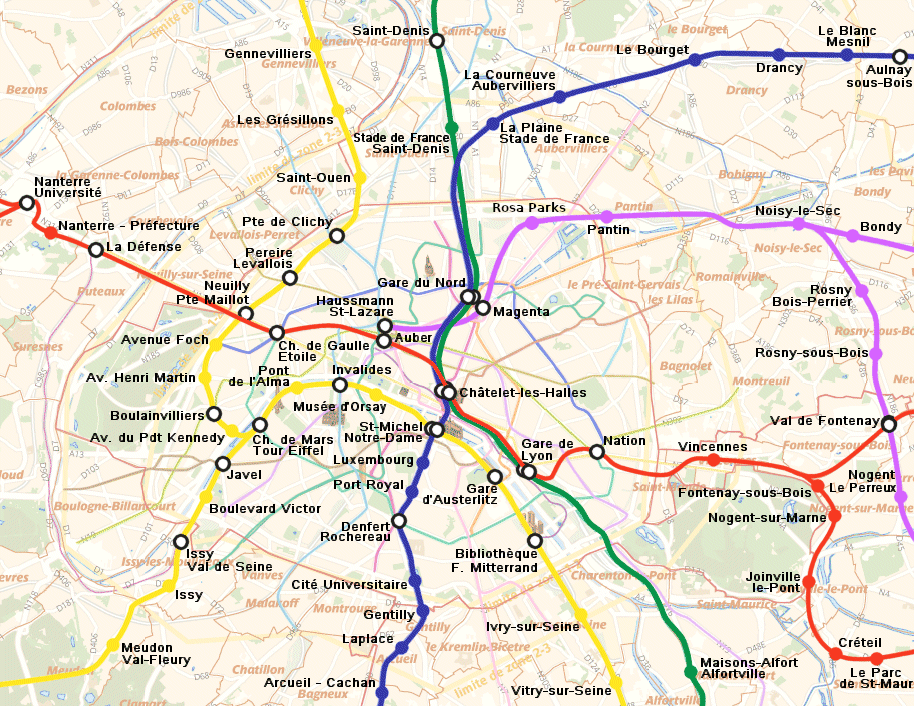
The principle isn't new: we already have Thameslink, running north-south through London (of which more in the next blogpost). But perhaps the best example is just over the channel in Paris: the RER (Réseau Express Régional) is a network of five lines criss-crossing the French capital, linking the suburbs to central Paris:
(from Wikipedia)
The RER lines connect suburban lines on either side of the French capital through a central tunnel. Indeed, RER Line A (in red) is uncannily similar to London's Crossrail: it connects western and eastern suburbs through a central tunnel, broadly parallel to Metro Line 1 but with many fewer stations. The RER has been vital in releasing capacity for medium- and long-distance trains to use Paris's six terminal stations like Gare du Nord and Gare de Lyon.

The same effect will happen at Paddington and Liverpool Street once Crossrail opens: rather than wasting as many as a third of the platforms at Paddington with local services, they will be removed to separate underground platforms and continue through to Liverpool Street and beyond, leaving more platforms at Paddington for long-distance services.

In order for that to be possible, we come to the third important difference between Crossrail and the parallel Central line: its tunnels will be the same size as mainline railway tunnels, and hence Crossrail's trains will be much bigger than tube trains.

London has long been hamstrung from being one of the pioneers of "tube" tunnels. The earliest LU lines - the modern-day Metropolitan, Circle, Hammersmith and City, and District lines - were built simply by digging up the road, laying down a railway line, and covering it over. This "cut-and-cover" method of construction was fairly easy, but it entailed colossal disruption to road traffic. Nonetheless, the tunnels were designed and sized for mainline trains, and the four "subsurface" lines remain by far the least claustrophobic part of the LU network.

Faced with the political impossibility of building more subsurface lines, attention turned from cut-and-cover tunnelling to the more novel method of boring a tunnel, without any need for direct access from above. The innovations of Brunel (senior and junior) in building the Thames Tunnel led to the Greathead shield, the first major design of tunnelling shield, and enabled tunnels to be bored through the soft clay of south London: without it, the tunnels would have collapsed under the weight of the soil above them before they could even be lined with iron or steel.

The City and South London Railway, now the Bank branch of the Northern line, was the world's first "tube" line with bored tunnels. It was also the first major railway to use electric traction, necessary if the deep tunnels were not to become filled with smoke and fumes. But the technology of the time allowed a tunnel diameter of just 10ft 2in (3.1m). Over the next two decades, improvements meant that the Central, Piccadilly and Bakerloo lines were all constructed to a common diameter of about 12ft (3.6m), with extensions to the Northern line following suit and requiring the hugely disruptive enlargement of the original C&SLR tunnels in 1923.

But there it stayed: any further enlargement of existing tunnels would have been (and would still be) effectively impossible - such is the dependence of London on its Underground that any lengthy closure of one of the lines usually causes chaos. The Jubilee line was essentially an offshoot of the Bakerloo line, so there wasn't much point building the new tunnels any larger since the old ones it had to run through were still only 12ft across.

However, the decision to build the Victoria line at the same diameter as the other four tube lines was motivated partly by a wish for compatibility, but mostly it was down to budgetary constraints (some would call it penny-pinching). Indeed, the whole Victoria line was built decidedly on the cheap and it suffers badly for it now, with stations too cramped and trains too small to truly cope with the volume of traffic.

Fortunately, the designers of Crossrail have learned their lessons: the Crossrail tunnels will be a comparatively giant 6.2m in diameter, giving tunnels with three times the cross-sectional area of the tube lines. Indeed, the impression is that nothing has been skimped from the budget at all: some of the stations will be absolutely huge, in stark contrast to the failings of the Victoria Line.

Canary Wharf station on the Jubilee line is famous for being almost cathedral-like in proportions; it was built out of a hollowed-out dock from the old docklands, and can quite happily absorb over 130,000 passengers a day. Canary Wharf Crossrail station, to be constructed from another hollowed-out dock, promises to be even bigger: the whole box will be 475m long - over a quarter of a mile!

Perhaps more important, though, is the upgrade work being undertaken at existing stations to ensure the new Crossrail services don't overwhelm the existing stations. Most notably, Tottenham Court Road station is already full to bursting at peak times with just the Northern and Central lines serving the station, and leaving it unaltered with the addition of Crossrail was not an option. So the station is being completely and painstakingly rebuilt, ensuring a total capacity for over 200,000 journeys per day once Crossrail is open.

From the outset, Crossrail will have 24 trains per hour (tph) in each direction through the central core in the rush-hours, made possible by automatic train operation (ATO). The parallel Central line has 33tph, but its trains have a much smaller cross-section and are only 130m long, compared to Crossrail's 200m-long mainline-sized trains. It is clear that Crossrail will undoubtedly do wonders for London's transport system, and its knock-on effects will reach all the way to Norwich and Penzance.

Nonetheless, there are some criticisms that I could make about Crossrail. Most importantly, having extolled the virtues of joining services on either side of the city together, there is something of a mismatch between the service level planned for the central core and the outer extremities: of the 24tph running through the central core, 14 per hour will only run as far west as Paddington, and only 10 will continue onwards towards Heathrow or Reading.

Partly this is due to lack of capacity on the GWML, and partly due to lack of demand; it's hard to see the GWML core from Paddington to Ealing, Southall and Hayes ever needing more than about 12tph in the near future. The ideal solution would really to be have another branch for the other trains to use west from Paddington; but while many ideas have been proposed, such as branches to Amersham, Kingston and Milton Keynes, none have yet come to fruition and the line will open with one main western trunk and two main eastern branches.

By contrast to the situation at Paddington, each of the two eastern branches - Shenfield and Abbey Wood - will get 12tph in the rush-hour. This will give Canary Wharf, an area that has been growing for decades, a much-needed capacity boost. The two branches will meet at Stepney Green Junction, which will be completely underground. Nonetheless, one could again argue that Abbey Wood is too close to central London to be an eastern terminus of Crossrail.

Fortunately, adding an extra western branch or extending the Abbey Wood branch can be done without the need for an underground junction, and is thus easy enough to add later on. In some ways it was more important to get the central core under construction and let the branches figure themselves out later; I cannot imagine Crossrail living past its first decade without any changes in the pattern of services, since the appearance of services on the ground always brings changes that cannot be predicted at the construction phase.

I could go on, and on, and on about Crossrail, for it is really quite fascinating; but ultimately we are only halfway to actually having a working railway line. So let me leave you with some links should you wish to read more about this epic project:
Next post: What is... Thameslink?

Saturday, 5 April 2014

A Network Rail Success Story: What Next for Dawlish?

The winter of 2013/14 will be remembered for quite some time as the stormiest in recent British history. On the night of February 4th, 2014, one of those storms thrashed the sea wall at Dawlish, in Devon, and the very foundations of the railway line were washed away, leaving 80 metres of track next to Riviera Terrace suspended in mid-air over nothing but the encroaching sea.

The railway line in question is the Great Western Main Line between London Paddington and Penzance. More importantly, however, it is the only rail connection between Plymouth and Cornwall and the rest of the country: while most long-distance routes have alternatives, once you get beyond Exeter there is but one route you can take to get a train to Cornwall.

On Friday, April 4th, two months after the tracks were washed away, the line reopened. Just eight weeks to rebuild a 100-metre section of sea wall from the very foundations, with workers only being able to work when it's not high tide, is nothing short of incredible and Network Rail deserve every award going for the amazing work they have done.

When Network Rail said in the days after the storm that it would be "at least 4-6 weeks" before the line reopened, many people looked at the pictures and thought it would be a lot more than that; the sheer scale of the damage was more or less unprecedented, and was clearly the biggest challenge the Network Rail team in the south west of England have ever faced. But they nearly managed to do it within six weeks; had it not been for a second storm on February 14th, which washed away another 20 metres of sea wall, they might very well have succeeded.

With the line reopened, the short-term panic over trains not running can at last subside. The focus should now turn to the long-term future of the rail network in Devon and Cornwall. On February 26th, Network Rail produced a list of options that they were considering:

  • reopening the London and South Western Railway (LSWR) route between Exeter and Plymouth via Okehampton and Tavistock (see this map);

  • create a new line between Exeter and Newton Abbot connecting two existing freight lines;

  • build one or more cut-off tunnels between Exeter and Newton Abbot to bypass the worst section of the sea wall.

However, there is a danger that, now the line has reopened, the impetus to look urgently at such plans will ebb away, and within six months most people will have forgotten that there was ever a problem with the railway line at Dawlish.

Frankly, maintaining the railway line along the sea wall at Dawlish has always been a matter of fighting a losing battle with the sea; Network Rail, just like King Canute, cannot stop the tide rolling in. It is, mile for mile, the most expensive bit of railway in the country to maintain, not least because of the salt spray rusting away at the rails. It is almost surprising that it's taken this long to have this serious a breach in the sea wall. Nonetheless, sea levels are rising, and coastal erosion is inevitable; eventually the sea wall - and the railway line that sits atop it - will all fall into the sea.

So what should be done? The trouble is that if those three options are the answers, it's not clear what the question is.

If the question is whether there should be a diversionary route that can be used as a contingency and otherwise simply provides a reasonable local service, then reinstating the LSWR route between Exeter and Plymouth via Okehampton and Tavistock looks, on paper, to be the "easiest" option: apart from a few buildings, the trackbed is reasonably intact and it wouldn't require any significant engineering works to reopen the line.

However, there are some downsides to this. Firstly, what parts of the line via Okehampton that are still open are all single-track; so while it would provide a reasonable contingency, it would be severely limited in capacity. (For more on this, see my blogpost and map from when I went to Okehmapton last summer.) Even getting a train every hour between Exeter and Plymouth on such a route would take some effort.

Secondly, the line is anything but a "main line". The existing GWR route via Newton Abbot is built as a mainline; admittedly it has a few steep gradients, but they're short and sharp, and much of the route is reasonably flat and straight. The old LSWR route isn't as steep, with a maximum gradient of 1 in 75 compared to 1 in 38; the difference is that it's a 25-mile climb at 1 in 75, followed by a 25-mile descent on the other side. So if we were to have to divert trains, they certainly wouldn't be as fast.

Most importantly, however, it's difficult to justify spending £100 million or £250 million (or however much the reinstatement of the LSWR route might cost) just for the few times a year when you might want to divert trains away from Dawlish. There has long been an argument for local services on the line, but that would probably need to be the main driver if the line were to be rebuilt; network resilience is great, but is it really worth paying £250 million rather than putting up with buses on the few occasions when Dawlish is shut?

However, if the question is about providing a replacement for Dawlish, then the LSWR route cannot be considered to be the (whole) solution. There is one simple reason for this: Torbay. The LSWR route provides a very good alternative route between Exeter and Plymouth and onwards to Cornwall; but it does nothing to provide an alternative route between Exeter and Newton Abbot, and I can't imagine that holidaymakers heading for the English Riviera would be willing to make a 50-mile detour via Plymouth.

So instead, one must consider a new connection between Exeter and Newton Abbot, more inland and resilient to storms than the Dawlish sea wall. Indeed, in 1933, the Great Western Railway proposed just such an avoiding line, but while survey and construction work began in Spring 1939, the outbreak of war halted the work and the land was sold off by British Rail after nationalisation.

While the second option above suggests using two freight branches which remain at either end, that would probably end up reducing the speed of the trains. With the Dawlish sea wall already the slowest part of the mainline between London and Plymouth (with trains limited to 60mph) it seems sensible to try and build a slightly faster railway as a cut-off. Such an avoiding line, however, would be a much bigger undertaking, especially given the amount of tunnelling that would probably be required. It would be a brand-new railway, and that comes with a much bigger price tag attached.

There is another spanner in the works: electrification. Much of the country's rail network is being electrified, with electric wires going up and electric trains replacing diesels. But in the Westcountry, the wires will stop at Bristol, at least for the time being, with services to Plymouth and Penzance being operated by diesel trains for at least a decade to come.

It's not clear whether Dawlish would ever be safe for 25kV electric wires, given the amount of sea spray that frequently comes over the trains (see this video at 2:15 and 7:00, among many others on YouTube). It may be that if Plymouth is ever to see electric trains, an inland diversionary route between Exeter and Newton Abbot will become a necessity. Then again, the railway line at Saltcoats, up in Scotland, is also exposed to the coast, and it is electrified (see this video for a storm at Saltcoats).

More importantly, however, the South West has done comparatively poorly out of recent railway investment plans; while lines across much of England, Wales and Scotland are being electrified and HS2 will bring far more capacity for long-distance services to the north, barely any investment is heading to Devon and Cornwall. I'd argue that reopening the line via Okehampton and building a faster avoiding route between Exeter and Newton Abbot are both necessary to bring the rail network of Devon and Cornwall up to a 21st-century standard.

I would like to see a wide-ranging discussion of the long-term future not just of the line through Dawlish, but the whole railway network in Devon and Cornwall; for too long the South West has suffered from having old trains and a lack of railway lines. Too often it seems like we don't do long-term infrastructure planning in this country; just this once I'd love to be proved wrong.

For now, though, I'd encourage everyone to do one thing: take a train along the Dawlish sea wall, preferably an HST with windows you can push down and peer out of. The experience of the sea air and the sight of cliffs on one side and sea on the other is simply magical, and unique to the line through Dawlish. And if this whole thing has taught us nothing else, it's that eventually the line will fall into the sea; so go, while you still can, and take a trip on the maddest, most precarious, most ridiculous, most glorious railway line in all of England.